
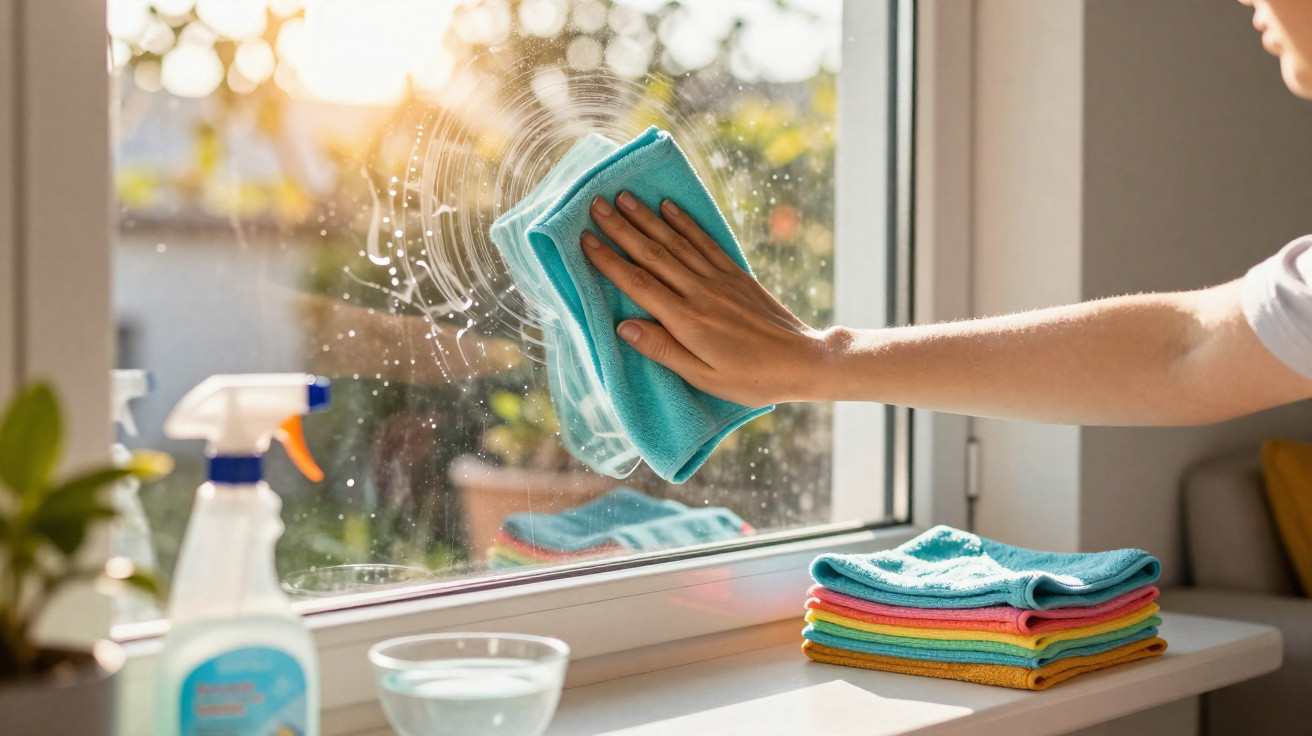
Many people then reach for even more sprays, homemade solutions or supposedly “magical” household remedies. The result is rarely convincing: a grey, smeared film, tiny fibres visible in backlight and dried water droplets. The real secret to streak-free windows is not another miracle product, but a simple fabric that almost everyone already has in a cupboard – together with the right technique.
Why windows still look cloudy and streaky despite specialist cleaner
Glass collects far more than visible dust. During everyday life, an almost invisible greasy layer builds up: fingerprints, cooking vapours, cigarette or candle smoke, and indoor pollutants settle on it layer by layer.
Repeatedly applying glass cleaner or a homemade cleaning mixture creates another issue: every cleaning session leaves residues behind. Once this mixture dries, it forms a dull haze that refracts light and becomes immediately obvious in sunshine.
The cloth itself is often the second mistake. Kitchen roll and old cotton rags may seem convenient, but they shed fine fibres and fluff. In backlight, these show up as pale streaks and tiny hairs on the pane.
Timing matters too: cleaning in direct sunlight means working against physics. Water evaporates faster than it can be wiped away, making drips, drying edges and marks almost inevitable. Cloudy days, the shaded side of the property or the evening are better choices.
“The problem is rarely too little cleaner – most of the time, it is too much of it combined with the wrong cloth.”
The secret helper: the fabric that replaces all cleaners
The unexpected star of window cleaning is not a spray but a material: the microfibre cloth. Many households already have one in the bathroom, among the car-cleaning cloths or in the kitchen.
Microfibre is made from exceptionally fine fibres with a large surface area. This allows it to absorb grease, dust and moisture rather than simply smearing them around. For streak-free windows, you need exactly two of these cloths:
- one high-quality microfibre cloth for the damp cleaning stage
- a second microfibre cloth that is completely dry for polishing
You also only need a small container of lukewarm water. No methylated spirit, washing-up liquid or vinegar: the glass is cleaned using water and cloth alone. Anyone who has relied on strong products or alcohol before will often notice the difference after the first attempt: less odour, less effort and more shine.
Clean windows in 5 minutes: the step-by-step method
The entire kit fits on a small saucer: around 250 millilitres of lukewarm water, one damp microfibre cloth and one dry cloth for the finishing touch. The key factor is how wet the first cloth is.
How to prepare the cloth properly
- Thoroughly wet the cloth in lukewarm water.
- Wring it out extremely well, until no drops fall when it is squeezed.
- The cloth should feel only slightly damp and cool, never soaking wet.
If the cloth is too wet, it will leave streaks and drips. When prepared correctly, it keeps the glass evenly damp without water running down it.
The S-motion: why it works so well
Rather than rubbing in circles, use broad S-shaped movements from top to bottom. It looks straightforward, but has a clear benefit: dirt is lifted and guided downwards instead of being spread around in circles.
- Begin at the top of the pane, on either the left or right depending on your dominant hand.
- Wipe downwards in smooth S-shaped passes with the damp microfibre cloth.
- Immediately repeat the same path with the dry cloth.
- Finish by working over the edges and corners carefully with the dry cloth.
An average-sized window can be completed this way in roughly five minutes. Drying as you go removes residual moisture and leaves the surface looking polished, without a film from glass cleaner.
“Switching from damp to dry in the same pass is crucial: loosen first, then absorb – do not spread it around again.”
How the method works on kitchen windows, mirrors and shower screens
Not every glass surface gets dirty in the same way. Grease, soap and limescale are additional factors in kitchens and bathrooms. With a few adjustments, however, the basic technique remains unchanged.
Greasy kitchen windows: two quick passes are better than one soaking-wet one
Grease splashes and cooking vapours accumulate on windows near the hob. Instead of soaking the cloth, two light passes work more effectively:
- First pass: use the slightly damp microfibre cloth in S-shaped movements to loosen the heavier grease film.
- Second pass: use the slightly damp cloth again, then polish straight away with the dry cloth.
If preferred, particularly greasy spots can be treated briefly and directly with a minimally damp area of the cloth before the first pass. The important point is not to add washing-up liquid to the water. It leaves precisely the film you are trying to avoid.
Mirrors and shower screens: speed prevents limescale marks
Bathroom mirrors and glass shower screens are prone to water marks, soap residue and limescale. Here, speed when polishing afterwards is what matters.
First move quickly across the surface with the damp microfibre cloth, then follow straight away with the dry one. If droplets form and begin to dry, the familiar marks will appear. Polishing immediately lifts away limescale water and soap residue.
Large glass surfaces: how to stay organised
Patio doors and panoramic windows can seem daunting, but they are manageable with a systematic approach. Working in sections is useful.
- Mentally divide the pane into vertical strips.
- Start at the top of the first strip and complete it all the way to the bottom.
- Finish that same strip with the dry cloth before moving to the next one.
- Never wipe back over an area that has already started drying.
Anyone who cleans regularly can keep one microfibre cloth exclusively for glass. It should be machine-washed regularly without fabric conditioner, as conditioner coats the fibres like a film and reduces their absorbency.
“A dedicated microfibre cloth for glass stays grippy for longer and prevents kitchen grease from reaching the windows.”
What to look for in microfibre cloths
Not every cloth performs equally well. A few features can help when choosing one:
- a dense, soft weave rather than a coarse terry-cloth surface
- no hard seams or edges that could cause scratches
- a medium-sized format that sits comfortably in the hand
Many cheap microfibre cloths are too coarse or quickly lose their structure. Anyone who regularly cleans glass surfaces is better off investing in two or three reliable options. With proper care, they can often last for years.
More than appearance: why streak-free windows have noticeable benefits
Clean panes are not simply about having a better view outside. Clear glass lets more daylight into a room, changing how it feels and reducing the need for artificial lighting. A brighter room feels noticeably friendlier, especially during the darker months.
There is also an environmental benefit: avoiding glass cleaner and mixtures saves plastic bottles, chemicals and fragrances, which are not always harmless for indoor air or skin contact. Water and cloth are much more suitable for children, pets and sensitive people.
This method also has a welcome side effect: it reduces cleaning stress. There is no measuring out mixtures and no searching for the right spray. A bowl of warm water and two cloths are all that is needed to create a clear view in a few minutes.


Comments
No comments yet. Be the first to comment!
Leave a Comment