
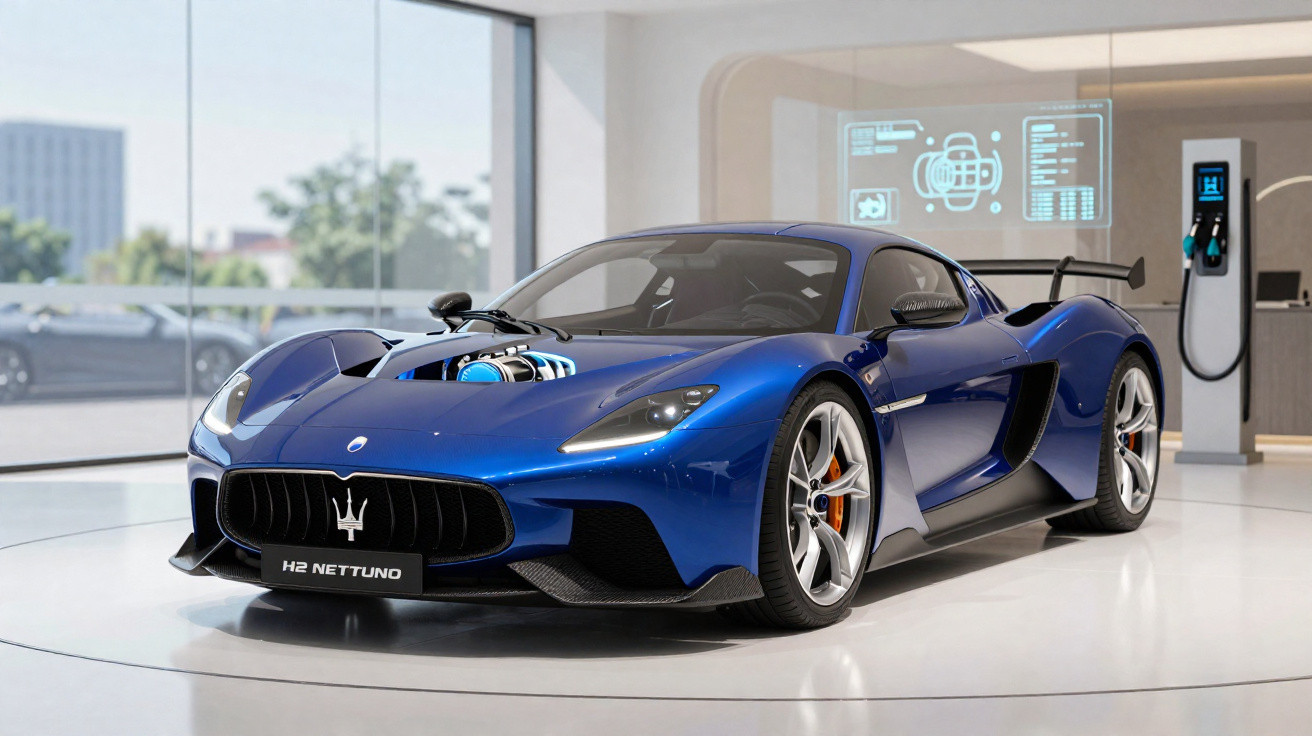
If the internal-combustion engine still has further chapters to write, they may perhaps be written without a single drop of petrol. That is the prospect Bosch is investigating by using hydrogen as a fuel.
Toyota has been the most prominent advocate of this technology, though it is far from alone. Bosch is another company pursuing it, and it has selected an unconventional platform to demonstrate how far the approach can go.
The starting point is Maserati’s Nettuno: the 3.0-litre twin-turbo V6 introduced in the MC20, featuring a pre-chamber combustion system. This Formula 1-derived technology was designed to improve combustion efficiency.
Bosch Motorsport has adapted the Nettuno to run on hydrogen, and the initial outcomes are especially noteworthy: this version already exceeds the power and torque figures of the petrol Nettuno used in the Maserati MCPURA.
More powerful than the petrol Nettuno
The engine has been fitted to the Ligier JS2 RH2, a prototype jointly developed by Bosch Engineering, Ligier Automotive and Maserati. The project began in 2021, while its first demonstrator was unveiled at the 24 Hours of Le Mans in 2023.
The concept has continued to develop ever since. While the latest iteration retains parts from the original Nettuno, including both cylinder heads and the turbochargers, it has received several changes to enable it to burn hydrogen.
Its pistons have been redesigned, with their new shape allowing the compression ratio to be lowered. The ignition system and engine control unit have also been revised.
However, the most significant change may concern fuelling. The production Nettuno combines direct and indirect petrol injection. In this hydrogen engine, Bosch uses only direct injection, supplied by its new HIDI LCV injectors.
The result is approximately 480 kW, equivalent to 653 hp, and 880 Nm. By comparison, the petrol-powered 3.0-litre V6 in the Maserati MCPURA produces 630 hp and 720 Nm.
More significant than the outright figures is the reliability shown so far. Bosch says that the Ligier JS2 RH2 and its engine have already covered almost 8000 km of circuit testing, in varying weather conditions, without technical issues.
It remains an internal-combustion engine
An important distinction needs to be made. This is not an electric car powered by a fuel cell, such as the Toyota Mirai. Hydrogen is fed directly into the engine and combusted in the cylinders, just as petrol is in a conventional engine.
The benefit is that hydrogen contains no carbon, meaning its combustion does not directly create fuel-derived CO₂. That does not make the exhaust entirely emissions-free, however. High combustion temperatures can produce nitrogen oxides (NOₓ), which is why controlling the combustion process remains crucial.
There is another decisive factor: the source of the hydrogen itself. For lower carbon emissions to make sense from an overall perspective, it must be produced using low-carbon energy sources, ideally renewable ones.
Bosch does not intend to replace electric vehicles
Bosch does not view the hydrogen engine as a universal replacement for battery-electric vehicles or fuel-cell systems. Instead, it sees it as an additional solution for products where, in its words, durability, high power and rapid refuelling are particularly important.
For now, the hydrogen Nettuno engine remains limited to the prototype world. Ligier itself has already suggested that the project could develop in several directions, including a track-day car combining Maserati technology with Bosch hydrogen systems.

Comments
No comments yet. Be the first to comment!
Leave a Comment