

At 7:23 p.m., your kitchen resembles a crime scene. A gleaming cordless vacuum is propped in the corner, an open, half-empty bottle of “deep degreaser” is on the worktop, and your phone is still displaying last weekend’s overambitious cleaning checklist. The sink has filled up again. Crumbs have returned to the floor. The bathroom mirror still has the toothpaste speckles it wore on Tuesday.
You have not become lazy. Your system simply… fell apart.
That is the understated betrayal behind most cleaning methods promoted online. They look flawless on paper, deliver a satisfying sparkle on day one, and then collide with the solid brick wall of ordinary life.
Those colour-coded routines are missing something essential.
Why smart cleaning systems collapse in real homes
Most cleaning systems are designed like diet plans: rigid, highly detailed and entirely disconnected from the way people really live. Printable charts assume peaceful evenings, empty weekends and energy levels that never dip. That is not a system; it is a fantasy.
Actual homes operate through rituals you hardly register. The coffee mug you automatically leave in the sink. The shoes you fling off in the hallway. The bag that ends up on the same chair every evening. If a cleaning plan overlooks these tiny movements, it is working against you every day.
Consider Laura: she is 34, has two children and works a hybrid job. In January, she buys a “whole home reset” course. It includes zones, timers and a five-page PDF explaining what to clean each day. During the first week, she is unstoppable. She shares before-and-after pictures. Her worktops gleam. For the first time in months, every laundry basket is empty simultaneously.
By the third week, though, the zones have become a haze. A single difficult day of meetings and a poorly child breaks the entire system. The PDF remains attached to the fridge, while the home gradually returns to its former rhythm. What remains? One small practice: she continues wiping the dining table immediately after dinner, almost automatically. It is the only element of the “system” that connected with a habit she already had.
That is the unspoken rule: a cleaning system that disregards daily habits eventually relies on willpower alone. Willpower works brilliantly on Monday morning and after you have watched a TikTok about “clean girl aesthetics”. It is far less reliable after a 10-hour shift and a delayed bus.
Our brains are drawn to shortcuts. We prefer following routes we already use. When a cleaning method is not connected to those routes, it turns into mental clutter. You must remember it, choose to do it and then push yourself through every stage. That is draining. The system did not fail because you are untidy. It failed because it did not account for the real flow of your day.
How to anchor cleaning to the habits you already have
A system that can withstand real life begins small and attaches itself to actions you already perform without thought. Think of it as hitching a lift on your existing habits. Rather than creating a new 30-minute “evening cleaning” slot, add a 30-second task to a moment that is already there.
Do you always wait for the kettle to boil? Use that time to wipe the hob. Do you shower each evening? Quickly squeegee the glass afterwards. Do you scroll on the sofa after dinner? Make that your two-minute reset: deal with the coffee table and cushions first, then pick up your phone. The habit is the train, and the cleaning task is simply an extra stop.
A frequent mistake is attempting too much too soon. You binge-watch cleaning TikToks, feel motivated and abruptly decide you will “reset the whole house every night”. It lasts… three days. Then life intervenes, and the reset becomes an all-or-nothing routine that you quietly stop doing.
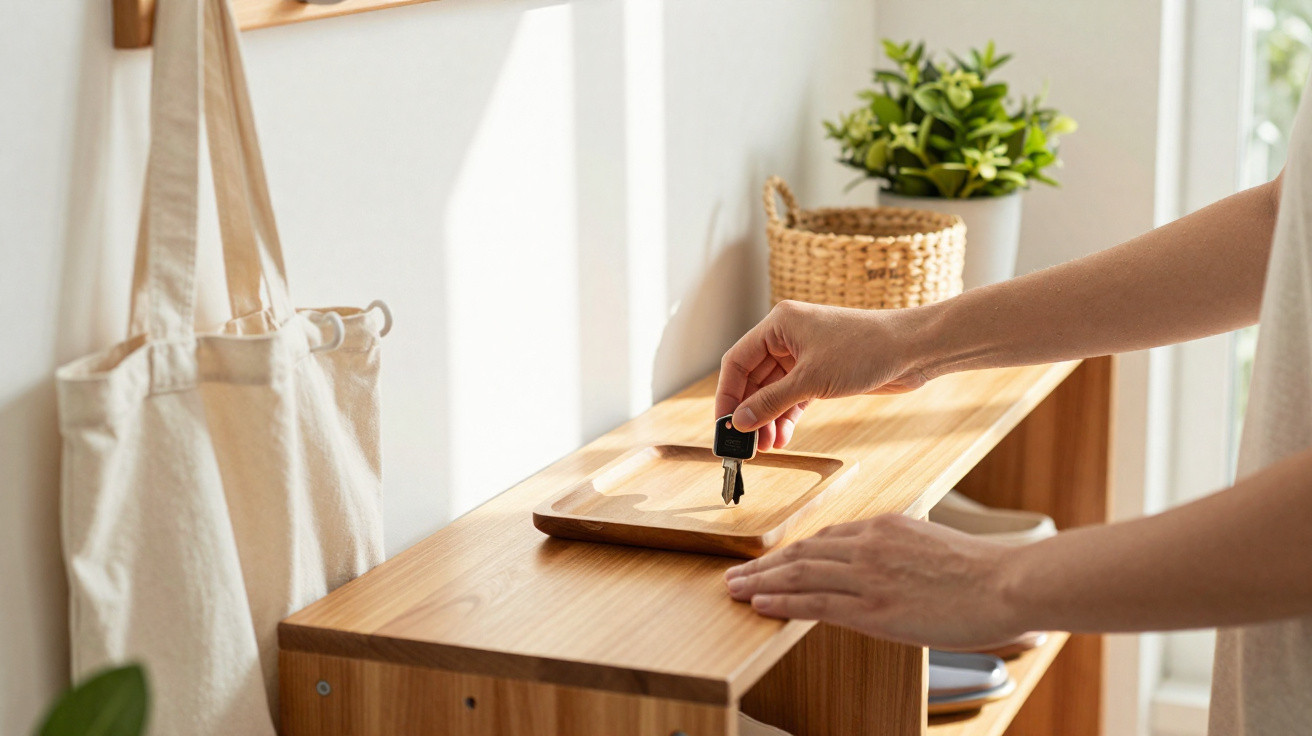
A kinder, more realistic option is to choose the area that frustrates you most, then tie one micro-action to one familiar habit. Are shoes scattered across the hallway? Place a low basket exactly where they are usually dropped and introduce one rule: remove your shoes, put them in the basket, then set down your bag. That is all. No grand announcement and no huge reorganisation. Just one repeatable action that works with the way you already come home tired.
We don’t keep houses clean by having more discipline. We keep them clean by needing less of it.
- Choose a daily anchor: Pick something you genuinely do every day, such as making coffee, brushing your teeth, feeding the cat or turning on Netflix.
- Add one tiny task: Wipe one surface, clear one hotspot or start one load of washing. Not three tasks: one.
- Lower the standard without apology: “Clear the worktop” may mean removing three stray items, rather than creating Pinterest-style minimalism.
- Keep tools in view: Put wipes beside the sink, a basket near the stairs and a cloth by the mirror. If it is out of sight, it is out of habit.
- Leave the rest of the home alone: For 2–3 weeks, treat this single habit as a private experiment worth protecting. Everything else can remain imperfect.
The quiet power of designing for the life you actually live
Once you begin viewing your home as a map of habits rather than a battlefield of chores, your perspective changes. The pile on the chair stops looking like a failure and starts looking like information: perhaps the wardrobe is too full or too far away, or perhaps that chair sits within your routine’s “drop zone”. You may notice that the bathroom worktop becomes chaotic every morning because your skincare products are stored in three separate places.
Let us be honest: nobody actually manages this every single day.
The aim is not to become the mythical person whose home never appears lived in. It is to create cleaning actions that hold up on bad days: evenings when you are sad, mornings when you oversleep, or the week you are ill and the laundry wins the war. A sustainable system flexes around those moments, then gently guides you back when you have even half an ounce of energy available again.
That’s where daily habits beat any miracle product or 30‑day challenge.
If cleaning systems repeatedly fail you, the issue may not be motivation. It may be design. Most plans begin with the house you wish you owned, rather than the life you already lead. A better method is almost embarrassingly straightforward: observe yourself for a few days, then place cleaning tasks into the gaps that already exist.
You may still buy the lovely spray or the attractive basket. Yet the real magic is the gradual, quiet alignment between the way you move and the way your home functions. That is when cleaning no longer feels like a performance and begins to feel like background music.
| Key point | Detail | Value for the reader |
|---|---|---|
| Habits beat willpower | Systems connected to daily routines endure longer than inflexible checklists | Reduces guilt and mental load around housework |
| Start with one micro-action | Link a 30–60 second task to a habit you already have | Makes cleaning seem manageable even on low-energy days |
| Design for real life, not ideals | Notice natural “drop zones” and movement patterns at home | Creates a home that supports you rather than fighting you |
FAQ:
- Question 1: Why do I always abandon cleaning schedules after a few weeks?
- Answer 1: Most schedules are created for perfect days and depend heavily on willpower. When stress, exhaustion or unexpected events arrive, they no longer fit your reality, so your brain quietly rejects them.
- Question 2: What is one habit I can start today that really makes a difference?
- Answer 2: Pick one daily “reset point”: clear a single surface you see regularly, such as the kitchen table or coffee table, immediately after a fixed event like dinner or switching off the television.
- Question 3: How do I deal with family members who do not follow the system?
- Answer 3: Create obvious, simple “landing spots” - baskets, hooks or trays - exactly where they already leave items. Explain one small rule at a time instead of introducing an entire system.
- Question 4: Can I still do big cleaning sessions on weekends?
- Answer 4: Yes, but regard them as bonuses. Daily micro-habits are what prevent the home from completely derailing between those larger sessions.
- Question 5: What if I am naturally messy - can this really work for me?
- Answer 5: Being messy usually indicates that your environment and habits do not align; it does not mean you are doomed. For “messy” people, small actions linked to existing habits are often more effective than any strict routine.

Comments
No comments yet. Be the first to comment!
Leave a Comment