
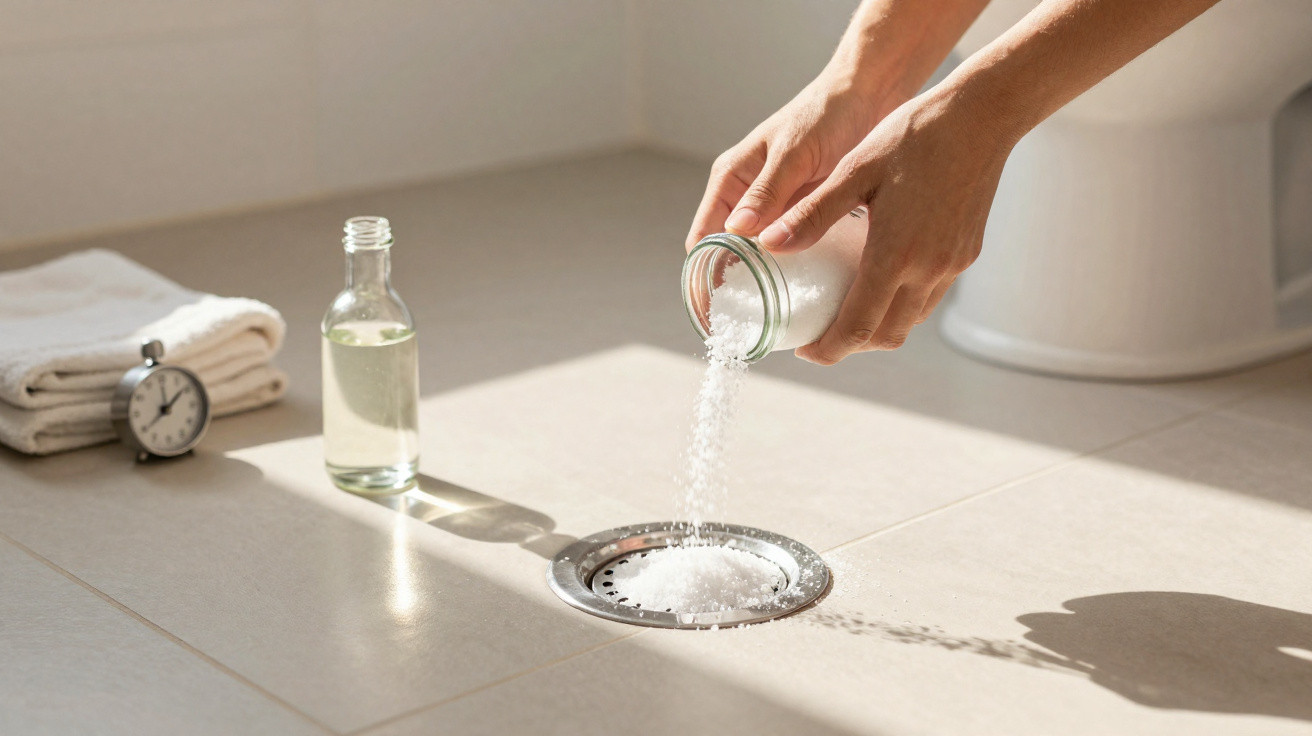
Pouring coarse salt down the bathroom drain once a week can help to lessen unpleasant smells, loosen light residue and keep drainage cleaner between regular cleans. The salt provides mild abrasion along the pipe walls and can help draw moisture from some of the built-up organic grime. This method works best as routine maintenance, rather than as a fix for a serious blockage.
What does coarse salt do for a bathroom drain?
Bathroom drains collect hair, soap, body oils, creams, dust and biofilm - a sticky layer that traps odours within the pipework. Fragranced products may mask the smell for a few hours, but they do not always reach the grime clinging to the inside walls.
This is where coarse salt can help with upkeep. Added dry to the drain and followed with hot water, it can loosen fresh deposits, reduce lingering moisture and lessen odours rising from the pipe after showering.
What is the right amount to use?
For a standard bathroom drain, the safest quantity is 1 to 2 tablespoons of coarse salt. This is enough to work effectively without creating a build-up in the pipework.
Apply it in this straightforward order:
- Remove hair and visible debris from the drain cover.
- Tip 1 or 2 tablespoons of coarse salt directly into the drain.
- Pour in around half a litre of hot, but not boiling, water.
- Avoid using the drain for 15 to 30 minutes.
- Finish by running water to flush away the loosened residue.
How long should coarse salt be left to work in the bathroom drain?
Leave it for at least 15 minutes. This gives the salt time to contact damp grime while the hot water softens soap and grease residue. If the drain has a stronger smell, it can be left for up to 30 minutes before rinsing.
There is no need to leave the salt in overnight every week. Where a bathroom has old plumbing, metal pipes or a history of blockages, prolonged and repeated use may not be the best option. Mechanical maintenance and cleaning the trap will usually be more effective in these situations.
How can it be combined with other ingredients without damaging the pipework?
Coarse salt may be used with bicarbonate of soda to strengthen its effect on odours and light organic dirt. White vinegar can also be used occasionally, but it should not be overused or mixed with strong products.
For a more thorough clean, follow these steps:
- Put 1 tablespoon of coarse salt into the drain.
- Add 1 tablespoon of bicarbonate of soda.
- Pour in half a cup of white vinegar and wait for the fizzing to subside.
- Leave for 15 minutes, then finish with hot water.
- Never mix it with bleach, chlorine or chemical drain unblockers.
How often should this be repeated in the bathroom?
Once a week is a suitable frequency for drains used daily, particularly in the shower enclosure. In guest bathrooms or rarely used areas, maintenance can be done fortnightly, but it is important to run water occasionally to prevent the water seal from drying out and allowing unpleasant smells to escape.
Coarse salt works best alongside physical cleaning of the cover, hair removal and rinsing with hot water. If water drains slowly, rises back through the drain, or the smell resembles strong sewage, the issue is no longer light dirt: there may be a blockage, a dry trap, a sealing fault or inadequate pipe ventilation.





Comments
No comments yet. Be the first to comment!
Leave a Comment