
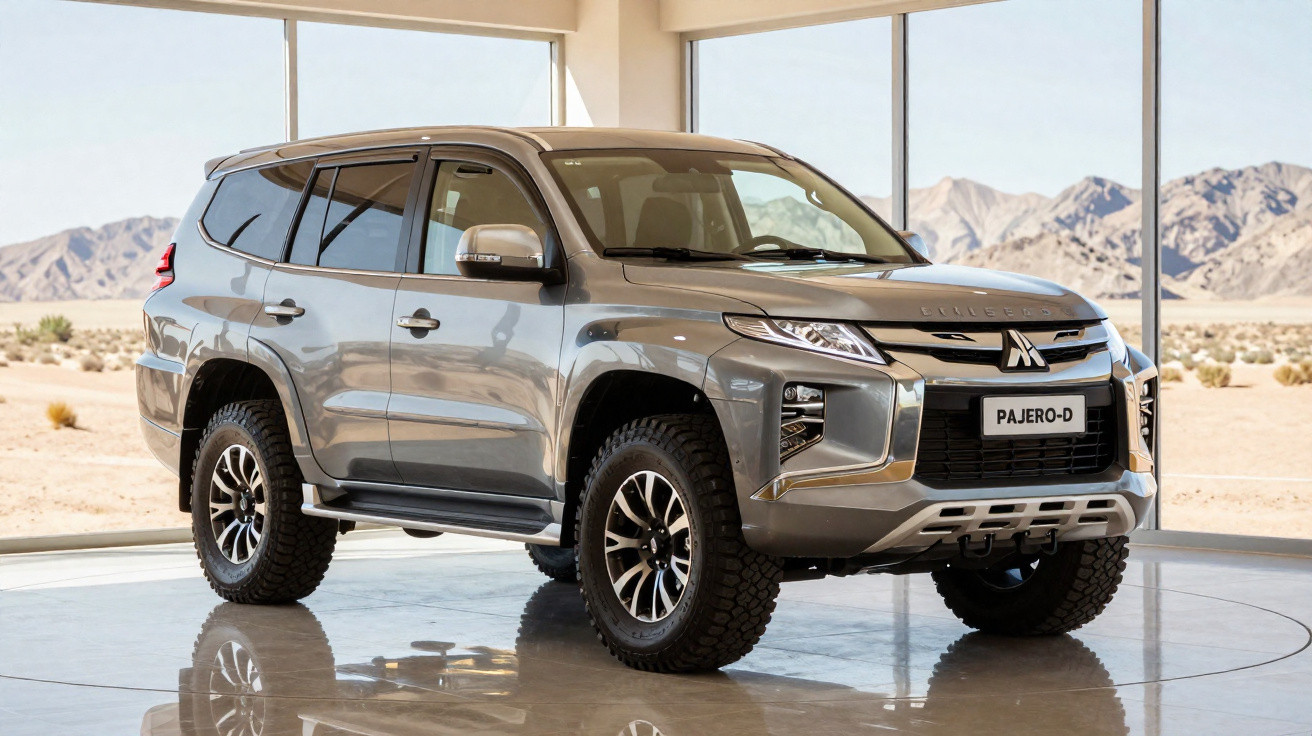
The Mitsubishi Pajero is one of those names that needs little introduction. Introduced in 1982, it won the Dakar 12 times - seven of those victories in succession - spanned four generations and played a major part in establishing Mitsubishi’s enduring off-road reputation.
It disappeared in 2021. For five years, the Pajero name appeared to have been consigned to the history books. Until now.
Mitsubishi has just unveiled an entirely new generation, and its formula is surprisingly familiar. A ladder-frame chassis and the Super Select 4WD-II system are among the key components, while, at a time when electrification seems to be reaching everything, the Pajero arrives with a Diesel engine lacking any electric assistance.
And this will only be the beginning. Mitsubishi has already confirmed that the Pajero will lead to a family of models, although it has yet to reveal what these will be.
The Mitsubishi L200 lies beneath the bodywork
Mitsubishi has not started with a blank sheet. Its basis is the tough ladder-frame chassis from the L200 pick-up, known as the Triton in other markets, albeit with a number of modifications. The company says it is more rigid thanks to the use of high-strength steels.
The suspension has also been tailored specifically for this model. At the front, there is a double-wishbone arrangement, while the L200’s rear leaf springs have been replaced by a new five-link live axle. Mitsubishi says this setup is better suited to balancing off-road ability with on-road comfort.
The new Mitsubishi Pajero is a sizeable vehicle. It measures 4.92 m long, 1.93 m wide and 1.91 m high, with a 2.87 m wheelbase. Those figures place it directly in Toyota Land Cruiser territory, which is shaping up to be its main rival.
Away from tarmac, it offers 230 mm of ground clearance, a 30.4º approach angle, a 22.6º breakover angle and a 25.8º departure angle.
Diesel remains in charge
There is another link to the L200 under the bonnet, in the form of a 2.4-litre four-cylinder Diesel engine. It is an evolution of the unit used in the pick-up and, in this application, gains a variable-geometry turbocharger.
Mitsubishi has not officially announced an output - several outlets report 204 hp - but it does state a maximum torque figure of 480 Nm. The Mitsubishi Pajero also receives a new transmission: an eight-speed automatic gearbox that even includes a Sport mode.
More significant is what the specification sheet does not contain: electrification. At least for now, Mitsubishi has not announced any partial or full electrification of the powertrain.
A Diesel engine and automatic gearbox may be a combination many would call old-fashioned in 2026, but it is precisely the setup many Pajero enthusiasts wanted to hear about.
Is it still a proper off-roader?
The Super Select 4WD-II system also returns, offering four settings: 2H, for rear-wheel drive; 4H, for permanent four-wheel drive; 4HLc, which locks the centre differential; and 4LLc, which adds low-range gearing.
This is joined by the S-AWC (Super-All Wheel Control) system, which coordinates several dynamic control systems, including Active Yaw Control - helping the vehicle turn and hold its intended line - a technology whose name will undoubtedly be familiar to Lancer Evolution owners and fans. There are also seven driving modes to tailor the vehicle’s responses to different surfaces.
The inclinometer returns
Mitsubishi has sought to revive several visual cues from earlier Pajero generations without resorting to a retro interpretation. Its silhouette is notably upright, the wheel arches are pronounced, and the C-pillar takes inspiration from the original Pajero.
However, one of the most interesting nods to the Pajero’s past is found inside. There is a new Multi-meter, which digitally reimagines the well-known supplementary gauges fitted throughout the Pajero’s various generations.
The inclinometer, present in the Pajero since 1982, makes a return. It is now accompanied by a compass and displays for altitude, outside temperature, longitudinal and lateral incline, and Active Yaw Control system operation.
The Multi-meter is integrated into the digital instrument display, which features two 14.3-inch screens - nostalgia in high definition. Lower-specification versions will receive smaller displays.
The rest of the cabin also reflects the Pajero’s move upmarket, as it now takes on the role of Mitsubishi’s flagship. There are seven seats across three rows, more carefully selected materials, three-zone automatic climate control and even a 12-speaker Yamaha sound system.
Is the Mitsubishi Pajero coming to Europe?
The new Mitsubishi Pajero will be built in Thailand, which will also be the first market to receive it. Japan and Australia will follow during the current Japanese financial year, which ends on 31 March 2027.
After that, Mitsubishi intends to expand sales to 100 markets worldwide, specifically naming countries in South-East Asia, Latin America and the Middle East. And Europe? That remains unconfirmed.
Europe was not included among the announced regions, although Mitsubishi has not yet committed either way on launching the Pajero in the “old continent”. The list of around 100 markets has not yet been finalised, leaving some hope for fans of the model.
Without wishing to dampen the excitement, the current-generation Mitsubishi L200 that provides the Pajero’s foundations is not even sold in Portugal. And a huge Diesel off-roader is likely to be difficult to reconcile with the European Union’s increasingly stringent emissions targets.


Comments
No comments yet. Be the first to comment!
Leave a Comment