
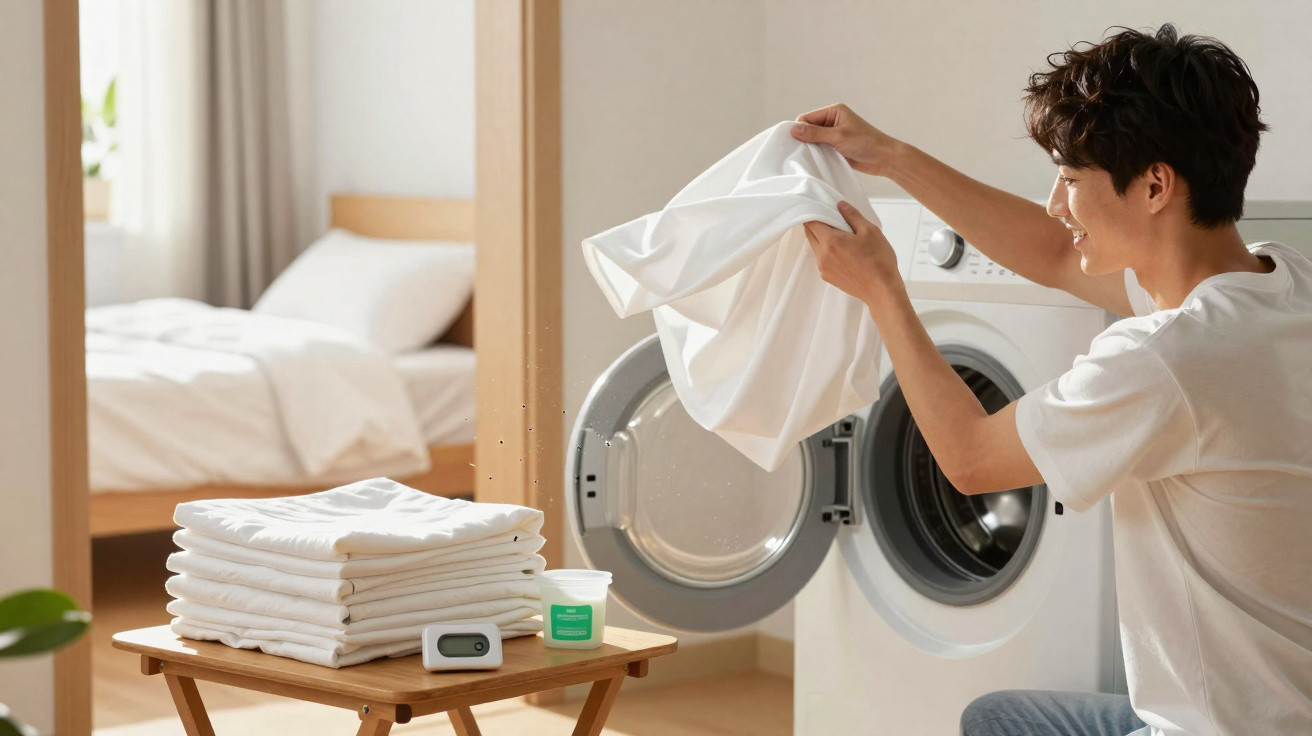
Few things feel better than getting into a bed made with freshly changed sheets at the end of the day. The scent of laundry detergent suggests cleanliness and calm. Yet plenty happens beneath this cosy surface: sweat, dead skin cells and sebum build up in the fabric night after night, creating ideal conditions for bacteria, fungi and house dust mites. This raises the key question: is 40°C enough, is 60°C necessary, or does the washing machine really need to run at 90°C?
What really happens in bed overnight
Sleeping produces moisture. The body can release up to half a litre of sweat each night. There is also:
- dead skin, which provides food for mites;
- sebum and residues from creams, make-up or body lotion;
- saliva and, occasionally, urine or blood;
- dust from the bedroom.
All of this ends up in the sheets and duvet covers. The longer they remain on the bed, the more concentrated the combination of dirt and micro-organisms becomes. Changing sheets only every three to four weeks unintentionally creates a small ecosystem.
Experts recommend washing bed sheets at least every 14 days, and ideally every week – particularly if you sweat heavily or have allergies.
Even if you wash bedding regularly, however, one central issue remains: which temperature delivers hygienic cleanliness while also protecting the fabric and your budget?
Washing bed sheets at 40°C: often enough, but not always
Many coloured-wash programmes operate at 40°C. For sheets with normal levels of soiling and no particular hygiene concerns, this is a sound standard setting. A wash at this temperature removes most everyday dirt provided that:
- a full-performance detergent is used;
- the programme runs for long enough;
- the machine is not overloaded.
Another benefit is that 40°C is gentler on fibres and colours. Cotton stays softer, elastane is less likely to lose its shape quickly, and prints and dyes retain their brightness for longer.
Your electricity bill also benefits. Comparisons show that a 60°C programme can use around half as much electricity again as a 40°C wash, while a 90°C cycle may use more than twice as much. Over a full year, this can make a noticeable difference if you wash bed linen frequently.
For healthy people in an average household, washing at 40°C is generally entirely sufficient when sheets are changed weekly or fortnightly.
When 60°C is genuinely worthwhile
There are nevertheless circumstances in which 40°C is not enough. In these cases, a 60°C programme has clear advantages, as higher temperatures reduce bacteria, fungi and mites much more effectively.
Typical situations requiring 60°C
- Illness in the household: flu, stomach bugs, viral infections or a persistent cough;
- Allergies: especially for people affected by house dust mites or asthma;
- Heavy sweating: night sweats or exercising shortly before bed;
- Young children and babies: more frequent “accidents” in bed and more sensitive bodies;
- People requiring care: weakened immune systems, incontinence or open wounds;
- Strong odours: smoke, pet hair or sheets that have not been changed for a long time.
In these situations, a 60°C wash provides considerably greater reassurance. Mites and a large proportion of germs are eliminated more effectively, and the smell of sweat is removed more reliably.
One additional tip is to add a splash of household vinegar to the fabric-softener compartment. This can neutralise odours and support the hygienic effect. Modern detergents with antibacterial properties can also offer an extra benefit, without requiring the temperature to be turned up every time.
90°C: an exception rather than the standard
As appealing as “boiling hot” may sound, 90°C is almost always excessive for bed sheets. Such high temperatures bring several disadvantages:
- cotton can shrink;
- colours fade quickly;
- fibres become brittle and thinner;
- energy consumption rises dramatically.
There are, however, rare exceptions where a 90°C programme may be appropriate: for heavily contaminated fabrics with blood or urine, where the material is particularly hard-wearing, or for a machine-cleaning cycle intended to descale the drum and flush germs from the system.
For everyday use, it is better to wash more frequently at 40°C or occasionally at 60°C than to rely on infrequent extreme washes at 90°C.
Which bed linen materials can handle which temperature?
The suitable temperature also depends on the fabric used for the bedding. It is always worth checking the care label first.
| Material | Everyday temperature | Sensible maximum |
|---|---|---|
| Cotton / renforcé | 40°C | 60°C |
| Percale / cotton sateen | 40°C | 60°C (rarely) |
| Linen, fine linen blend | 30–40°C | 60°C only if the care label permits it |
| Microfibre / synthetic fabrics | 40°C | 60°C for hard-wearing quality |
| Silk | 30°C, delicate programme | no 60°C wash |
Delicate materials last longer when they are washed on a gentle programme, at lower temperatures and with a low spin speed.
A simple everyday rule for clean bed sheets
If you do not want to make a fresh decision every time, use this straightforward rule of thumb:
- Healthy adults, normal sweating: wash bed sheets every 7–14 days at 40°C.
- People with allergies, heavy sweating or pets in the bed: wash weekly at 40°C or 60°C.
- A period of illness in the household: wash bedding once at 60°C after symptoms have subsided.
- Hard-wearing white cotton bedding: an occasional 60°C wash is possible to reduce germs more thoroughly.
Regularity matters more than continually selecting the highest temperature. More frequent washes at moderate temperatures are clearly preferable to rare extreme programmes, both for hygiene and in terms of environmental impact and electricity costs.
Common mistakes when washing bed sheets
Temperature is only one part of the equation. Many issues result from everyday washing mistakes:
- Overloading the drum: water and detergent cannot reach every area, leaving dirt in the fabric.
- Using a programme that is too short: quick washes often clean heavy cotton bedding only superficially.
- Choosing the wrong detergent: biological or heavy-duty detergent is suitable for white sheets, while colour detergent is intended for coloured ones.
- Not drying thoroughly enough: sheets folded while still damp develop odours and, in the worst case, mould.
Washing sheets separately, or only with similarly large textiles, also prevents everything from becoming tangled into one large ball and being cleaned unevenly.
Why mites in bed are a real concern
House dust mites are tiny arachnids that feed on dead skin cells. They thrive in warm, slightly humid surroundings – precisely the conditions found in mattresses, pillows and bed sheets. It is not the creatures themselves but their droppings that can trigger allergies and asthma symptoms in sensitive people.
Washing bed linen regularly at 40°C or 60°C significantly reduces exposure. The following measures can help too:
- mite-proof covers for mattresses and pillows;
- airing the bedroom frequently;
- not drying laundry in the bedroom;
- keeping humidity low, ideally below 60 per cent.
Practical examples for everyday life
An active single person who often goes to bed sweaty in the evening will do well with a weekly 40°C wash. After especially intense periods, such as during high summer, an occasional 60°C cycle may be sensible.
For a family with two children who occasionally wet the bed or catch stomach bugs, washing children’s sheets at 60°C more often is particularly worthwhile. Parents’ bedding can remain on a 40°C programme when used normally.
An older person with a weakened immune system benefits from higher temperatures and frequent changes of bedding. In this situation, hygiene clearly takes priority over protecting the fabric, as long as the material can withstand 60°C.
Save energy without compromising hygiene
Saving electricity does not automatically mean accepting unclean sheets. Three factors are decisive: an appropriate temperature, the correct detergent type and regular changing. A modern automatic washing machine with Eco programmes, combined with a 40°C setting, is sufficient in many cases to clean bed linen hygienically.
Only when illness, strong odours or particular health risks are involved is it worth selecting the 60°C button. A 90°C wash remains an absolute exception – for hard-wearing laundry and unusual circumstances, not for the weekly pile of bed linen.






Comments
No comments yet. Be the first to comment!
Leave a Comment