
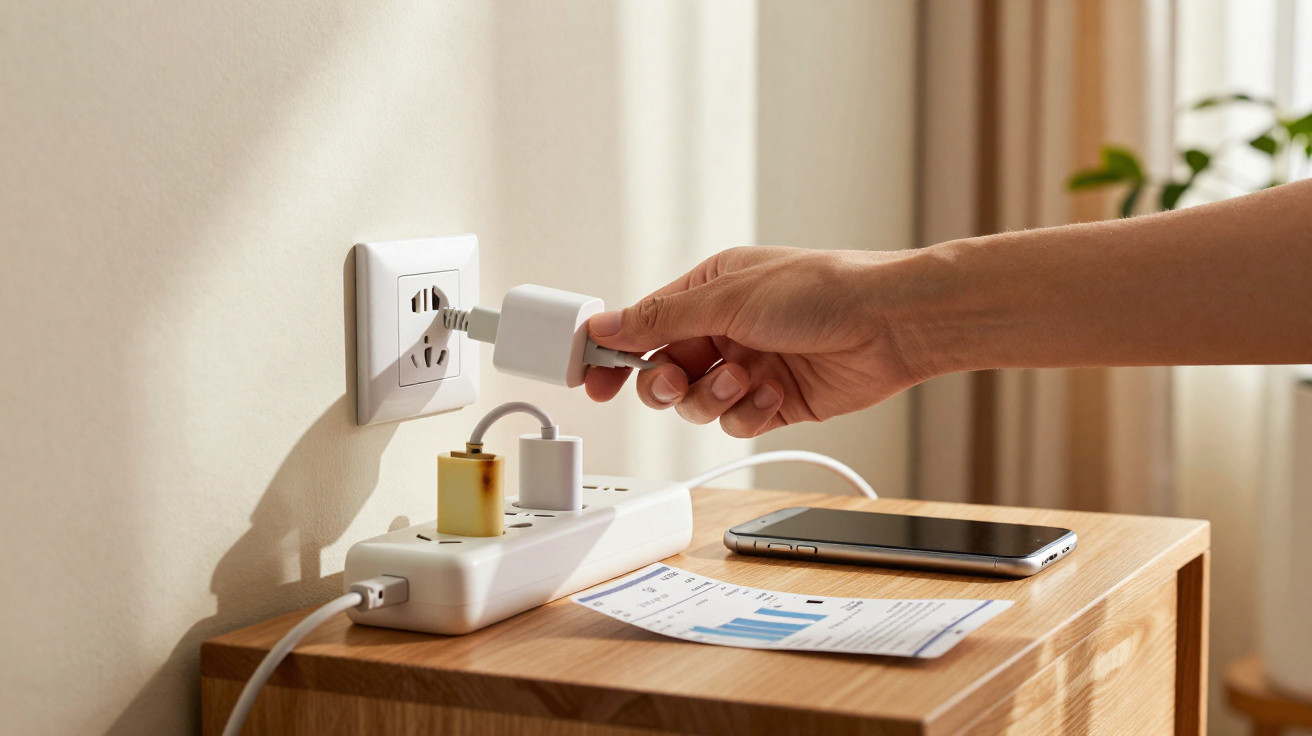
A seemingly harmless everyday mistake can have serious consequences.
Whether in the bedroom, beside the sofa or in the kitchen, chargers are left permanently plugged into sockets in countless homes, ready for the next charging session. Few people give this a second thought. Yet having a cable permanently to hand comes with two downsides: it presents a small, though real, fire risk and quietly increases electricity use.
Why a charger remains active even without a phone
A current phone or laptop charger contains a compact switched-mode power supply. Its purpose is to convert mains electricity into the lower voltage required by the device. That circuitry does not simply switch “off” because no smartphone is connected.
As long as the plug remains in the socket, voltage is still applied to its components. The transformer, capacitors and other parts remain on standby. In effect, the charger is in stand-by mode - and that is the crucial point.
A plugged-in charger with no device attached uses electricity, warms up slightly and can become a genuine hazard if it is poorly made.
With high-quality, certified branded chargers, the risk is manageable. They are designed for continuous connection and undergo stringent testing. The greater concern is with cheap products sold through online marketplaces or displayed beside the till in holiday shops.
Cheap chargers: when saving money becomes a fire hazard
Many exceptionally inexpensive chargers cut costs in precisely the areas where this matters most: insulation, component quality and safety clearances. As a result, they may deteriorate sooner, run hotter and respond more poorly to voltage fluctuations.
In practice, electricians repeatedly report:
- extension leads scorched by overheated chargers
- sockets with melted plastic housings
- a burning smell in bedrooms caused by a cheap power supply left plugged in permanently
In most instances, the outcome is limited to melted plastic and considerable inconvenience. Even so, the gap between a burnt plug and a smouldering fire is narrower than many assume - especially where several risk factors coincide, such as extension leads, dust, flammable materials nearby or ageing electrical installations.
The straightforward rule from electrical engineering professionals is: use certified chargers only - and unplug them once charging is complete.
How to identify a safe charger
Not every low-cost charger is automatically dangerous, but there are warning signs that should be taken seriously:
- no certification marks, such as CE or GS
- an exceptionally low weight, which may indicate few or poor-quality components
- an unpleasant chemical smell when unpacked
- substantial heat after only a short period of normal use
- loose plugs, unstable ports or visible gaps in the casing
If one or more of these signs appear, the device should not be left plugged in continuously - and, if in doubt, it should be disposed of.
The hidden electricity drain: everyday “phantom power”
Even where no fire occurs, leaving chargers connected has another frequently overlooked effect: so-called phantom power. This refers to the tiny amounts of energy that electrical equipment draws while on standby, despite not currently being used.
On paper, one charger consumes very little power while idle, often around 0.1 to 0.3 watts for newer, efficient models, although older or inferior devices may use considerably more. That may sound insignificant, but the power is drawn 24 hours a day, seven days a week.
A rough calculation:
| Situation | Power consumption (example) | Electricity used per year |
|---|---|---|
| 1 charger left plugged in permanently | 0.3 watts | around 2.6 kWh |
| 5 chargers left plugged in permanently | 0.3 watts each | around 13 kWh |
For one household, this may still seem unremarkable. It becomes more significant when projected across millions of homes: very small amounts turn into vast quantities of needlessly consumed energy - and corresponding CO₂ emissions.
The scale of the household effect
Studies by energy agencies show that equipment on stand-by or unused power supplies can account for up to ten per cent of a household’s total electricity consumption. Chargers represent only part of this, but they are closely tied to daily life: almost everyone owns several, for smartphones, tablets, notebooks, smartwatches, headphones and more.
Every power supply left connected permanently is like a slightly opened valve on an electricity line - barely noticeable on its own, but a clearly measurable loss in combination.
Three simple habits that help straight away
Using chargers sensibly lowers the risk of damage while also saving electricity. The most effective measures are surprisingly straightforward:
- Unplug after charging - disconnect the phone, then remove the charger from the socket.
- Use only tested, certified power supplies, ideally those made by the device manufacturer or reputable brands.
- Choose switched extension leads, so several chargers can be fully disconnected from the mains at the press of a button.
Anyone who makes a habit of unplugging the charger immediately after charging will barely think about it after a few days. It becomes routine, much like switching off the light when leaving a room.
Where chargers can become hazardous particularly quickly
Certain locations and situations increase the risk when chargers remain in the socket permanently:
- under pillows or duvets: heat cannot escape, so warmth builds up around the device.
- trapped behind furniture: cables can be crushed, plugs may sit at an angle and dust can collect.
- old or damaged sockets: contact resistance is higher, and contact surfaces can become red-hot.
- children’s bedrooms: children may play with cables and plugs, pulling, bending or overloading them.
In these settings especially, it is worth limiting the number of devices connected to a socket and taking particular care over the quality and condition of the hardware.
What terms such as phantom power and stand-by really mean
Many consumers hear these terms but find them difficult to place. Phantom power describes electricity consumption that remains “invisible” because no device is actively operating: no screen is lit and no motor is running. Nevertheless, power supplies, routers, receivers and televisions in stand-by mode continuously draw energy.
Stand-by usually refers to an operating state that allows a device to start again quickly - for example, a television that can be switched on at any time using its remote control. A smartphone power supply works in much the same way: it remains ready for the next charging session even when no phone is attached.
The physical explanation is straightforward: electronic equipment needs a certain amount of base energy to remain “ready to receive”. Reducing this base load cuts energy demand without requiring any loss of convenience - flicking the switch on an extension lead is enough.
Practical examples from everyday life
A careful look around the home often reveals more permanently active power supplies than expected. Typical examples include:
- chargers for old smartphones that were discarded long ago
- power supplies for retired routers, speakers or games consoles
- USB charging stations that remain connected all the time despite only being used occasionally
A brief walk around the home is enough to uncover several “electricity leaks”. Identifying them and unplugging the devices not only reduces fire risk, but also brings electricity consumption down to a far more sensible level.
Ultimately, avoiding permanently plugged-in chargers has benefits on several fronts: it protects the home against unnecessary dangers, saves money and reduces pressure on electricity networks. It takes only a few seconds a day, while the benefits accumulate over the years.






Comments
No comments yet. Be the first to comment!
Leave a Comment