
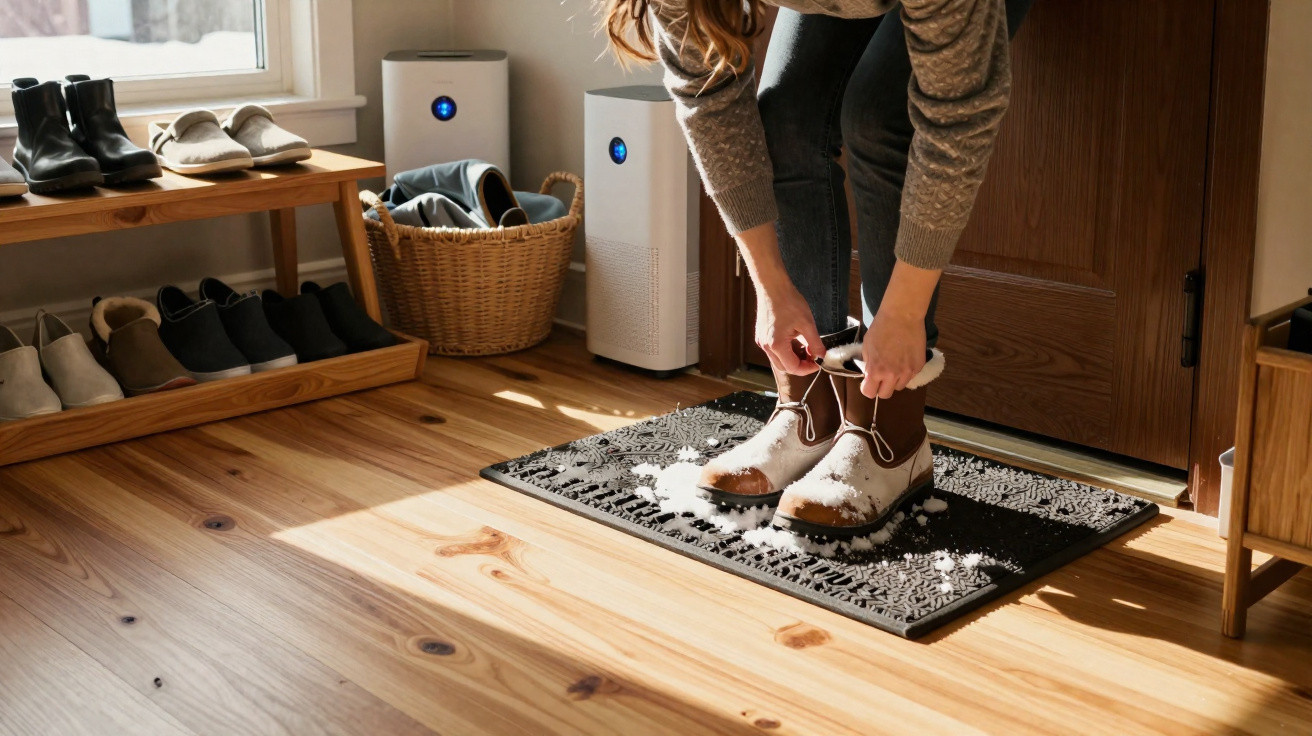
The first boot hits the hallway tiles with a damp slap.
A pale grey mark spreads around the sole, slowly unfurling across the floor like a storm cloud. Two school bags slam into the wall, somebody calls from the kitchen and the heating rumbles in the background. Beyond the door, the pavement is coated in frost and brown slush. Indoors, your floors are fighting a losing battle.
There is a crust of salt on the mat, a muddy streak heading towards the living room and a questionable sprinkling of something that could be grit… or yesterday’s cereal. The dog is already investigating the wet laces. With a cloth in one hand and a shoe in the other, you get that small flash of worry: if this is only winter’s third day, what will the sixth week bring?
There is a different way to handle winter shoes. It begins before that first boot reaches the floor.
The hidden mess winter shoes bring into your home
The main issue with winter shoes is not simply the dirt you can see. It is the subtle, unseen layer they leave behind. Each step brings in a mixture of road salt, pollen caught in wet leaves, mould spores from damp pavements and fine dust that clings to rubber as though it were Velcro.
On a sunny day, it can be visible: a slight sheen on a dark wooden floor, the dusty outline of a dried footprint on tiles or tiny light flecks pressed into the carpet. During a grey afternoon, you notice it beneath your socks instead: faintly gritty, never entirely clean and always present.
Now picture this occurring ten, twenty or fifty times each day. Everyone in the household follows the same routes: from the door to the kitchen, from the stairs to the sofa. Gradually, the particles fan out. For anyone with allergies or asthma, that almost invisible trail can make every step feel like walking through a cloud.
The figures are stark. One US study found that people carried nearly a third of the lead dust in their homes indoors on their shoes. European research has also identified rises in indoor pollen levels on wet days with heavy foot traffic. It is not only mud that gets tracked through the house, but everything the mud picked up from the pavement.
Consider an ordinary winter Saturday: a supermarket visit across a salted car park; a brief trip to the park, where paths are a mixture of leaves, grit and dog mess residue; or stopping for petrol and unknowingly stepping into an oily puddle. At every location, a little of the outdoors becomes lodged in the grooves of your soles.
By the time you return, your soles resemble a memory stick filled with microscopic files. Not all of it comes off in the hallway. Some lands in the kitchen when you wait too long to remove your boots. More drops in the living room when you go back for the bag you left behind. A little stays attached until you climb the stairs and finally fling your shoes off on the landing.
Floors are not dirtied by one dramatic incident. They become dirty through hundreds of tiny moments that are easy to forget. Allergens move with the same slow persistence. Dust mites thrive on the extra dampness from wet footwear, while mould around doorways can spread more quickly when floors remain wet for hours. The encouraging part is that, if this accumulation happens one step at a time, it can be reduced the same way.
The winter shoe routine that protects your floors and sinuses
The strongest measure is also remarkably simple: establish a “shoe border” at the entrance and treat it as the boundary between two countries. One side is wet, salty and gritty; the other is dry, soft and breathable. The key is making that boundary so effortless that nobody needs to remember it consciously.
Begin with three items: a hard-wearing outdoor doormat, an absorbent indoor mat and a designated shoe area no larger than a small rug. Nothing more is required. The outdoor mat removes the worst grit and ice melt, the indoor mat absorbs moisture, and the shoe area keeps everything in one place.
You do not need an immaculate Pinterest-style boot room. A low-cost boot tray, an old baking tray for children’s wellies or a shallow plastic crate lined with an old towel can work extremely well. The point is to catch what comes off rather than acting as though it is not there. Once that “border” is in place, small habits can develop around it.
A particularly easy improvement is a 10-second wipe-down rule for the biggest offenders. Think of it as a quick car wash for soles. Keep a cloth or reusable microfibre pad beside the shoe tray. When someone arrives with slush or obvious mud on their footwear, they step onto the indoor mat and then lift each foot briefly for a fast wipe of the sole.
This is where the real reduction in allergens takes place. Damp soles transport not just soil and road salt, but also the fine particles that can set off sneezing later that evening. Keeping that moisture on a cloth instead of allowing it to dry on the floor can transform the situation.
Will everybody follow the 10-second wipe rule every single time? Naturally not. That is exactly why the routine needs to be flexible rather than strict.
The usual error is taking an all-or-nothing approach. People purchase a pristine white shoe rack and a decorative jute mat that looks stylish on Instagram but cannot cope with moisture, then feel discouraged when both turn brown within a week. Another problem is positioning the rack too far from the entrance, meaning children and visitors cross half the hallway before remembering they should have taken their shoes off.
Let’s be honest: nobody truly does this every day. The solution is to plan for real, untidy human behaviour. Put the shoe tray exactly where an exhausted person would instinctively remove their boots. Select mats that are easy to shake outdoors and put in the washing machine. Accept that, on some days, the dog will get past you and race through with wet paws.
During difficult weeks, focus on containing the mess rather than achieving perfection. If footwear normally ends up scattered along the hall, allow it to spread… but only within the designated area. Then, even if the system breaks down, the impact is confined to one sacrificial section of flooring and fabric.
“Once we stopped pretending our hallway was a show home and treated it like a working airlock, the whole house felt calmer. The kids still forget, the dog still drips, but the mess has a place to land.”
The emotional aspect is seldom discussed, although it strongly influences whether a routine lasts beyond its first week. Small inconveniences destroy habits. Having to open a cupboard to find a shoe brush? That is too much effort. Looking for somewhere to hang wet laces? They will end up on the radiator every time.
A winter-ready arrangement is not about tidiness; it is about ensuring the easiest option is also the cleanest. This means coat hooks at children’s height, an open and visible basket for gloves, plus a brush or old towel left in plain sight rather than stored away “for later”.
- Put the indoor mat where the first natural footstep lands rather than directly against the door.
- Pick dark, patterned mats that disguise marks between washes.
- Alternate between two mats, so one can dry while the other is being used.
- Vacuum or shake out the shoe area twice weekly to prevent allergens from circulating again.
- Keep a simple spray bottle of warm water with a little mild cleaner for quick sole wipe-downs.
Living with winter mess without letting it take over your home
Most people do not want their front door to feel like a military checkpoint. They simply want to walk barefoot across the living room in January without collecting an unexplained crumb with every step. A gentle routine made up of a few deliberate actions can achieve that without making you the hallway police.
A useful change in perspective is to view winter shoe care as “daily dishes” rather than “spring cleaning”. You would not leave one mug unwashed for three weeks. Grit and salt are no different. A 30-second sweep at the end of the day around the shoe zone, using a hand-held vacuum or a quick pass with a mop around the mats, prevents particles reaching bedrooms, rugs and soft furnishings, where they are much harder to remove.
On days when the home feels like a drying room full of boots and sodden socks, that minor ritual can feel like taking your space back. Not flawless or Instagram-ready, simply calmly managed.
The unexpected advantage is noticeable in the air. Those with dust or pet allergies often say that their indoor symptoms worsen in winter rather than during hay fever season. Homes remain closed, which plays a part, but every wet sole and damp paw also turns the entrance into a launch point for irritants.
When less dirt gets beyond the first few metres, your next vacuuming session genuinely clears it away instead of merely redistributing it. Air filters block up more slowly. Radiators are not covered in the same fine grey coating. You may notice fewer unexplained sneezes beside the sofa and fewer itchy eyes after an evening on the floor with children or pets.
An effective routine does not need to be elaborate. A London home allergist captured this in a memorable line: “Stop thinking of your floor as a passive surface. Treat it like a lung. What lands on it will be breathed, sooner or later.” It is a mildly unsettling thought, but it makes taking that extra moment at the door seem unexpectedly worthwhile.
There is also a quiet satisfaction when the arrangement starts working. Your teenager casually puts their boots on the tray without being prompted. A visitor automatically uses the mat and asks, “Where did you get this? It actually dries my shoes.” Or there is the small pleasure of walking through the hallway in socks and feeling… nothing. Only floor.
You may still find the occasional stray footprint on the stairs. The dog will still locate the one remaining puddle on the pavement and carry it home like a trophy. Even so, the overall feeling in the house changes: less frustrated wiping, more quick and nearly automatic habits that keep winter’s worst effects circling outside the main living areas.
Perhaps that is the real benefit of a winter-shoe maintenance routine: not immaculate floors, but the feeling that your home is standing up to the season. On long grey evenings, with wet boots arranged by the door like sleepy soldiers, that is more than enough.
| Key point | Detail | Benefit for the reader |
|---|---|---|
| Create a “shoe border” | Combine an outdoor doormat, an absorbent indoor mat and a dedicated shoe area | Immediately reduces the amount of dirt and allergens entering the rest of the home |
| Adopt short but regular actions | Quick sole wipe-downs, a brief vacuum around the zone and mat rotation | Keeps floors noticeably cleaner without creating a huge mental burden |
| Design for real life | Keep equipment visible, easy to reach and positioned where shoes are genuinely removed | Turns good intentions into lasting habits that the whole family will accept |
FAQ:
- Should I always make my guests take off their shoes in winter? It’s your call, but offering a clear shoe zone and a couple of pairs of clean house slippers makes the choice easier without feeling strict or awkward.
- Are washable slippers or indoor shoes really worth it? For allergy sufferers they can be a small game-changer, because they keep feet warm while avoiding the dust and pollen trapped in socks worn inside shoes.
- How often should I wash my entrance mats in winter? For busy households, every 7–10 days is a good rhythm; shake them outdoors midweek to remove grit and trapped allergens between washes.
- Does a robot vacuum help with winter shoe dirt? It can, if you run it regularly around the entrance and main walking paths, but it doesn’t replace scraping mats and a basic shoe routine at the door.
- What’s the quickest thing I can do if I’m too tired for a full routine? On low-energy days, aim for just one action: either shake the mats outside or do a 30-second sweep or vacuum around the shoe zone. That alone slows the spread.

Comments
No comments yet. Be the first to comment!
Leave a Comment