
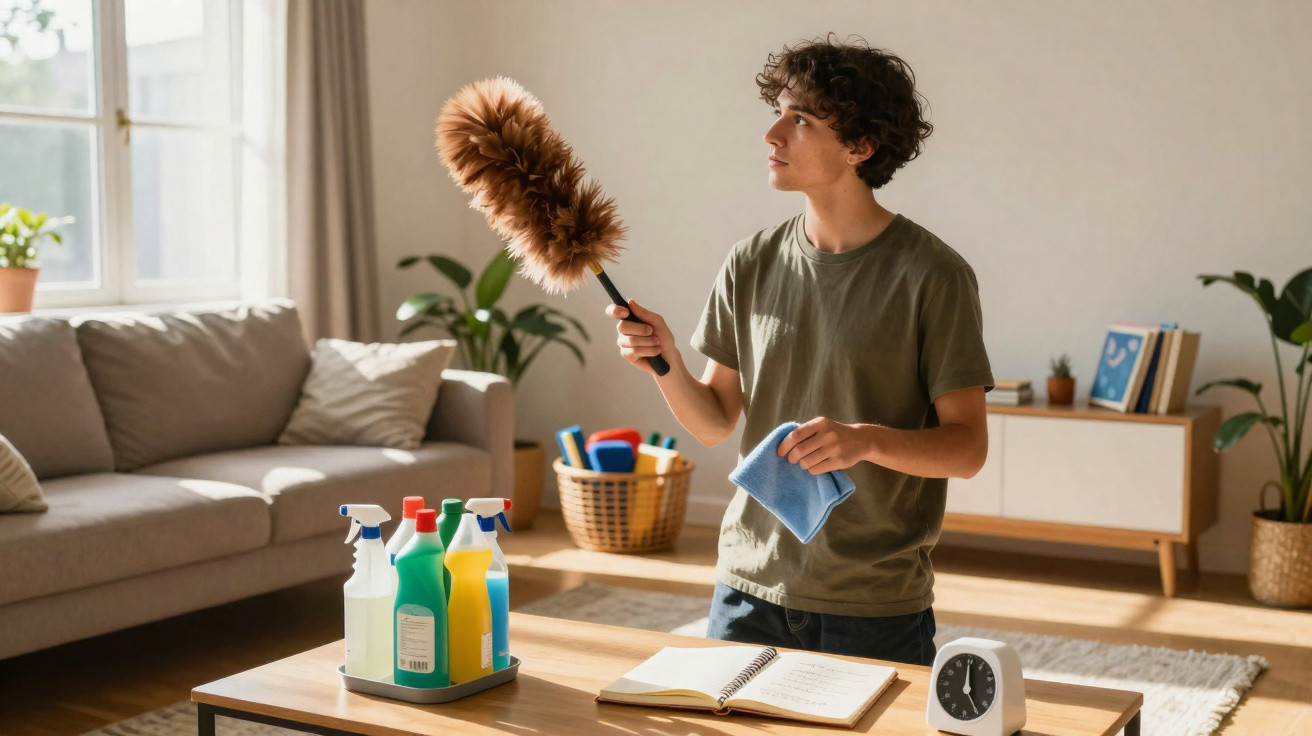
The realisation came to me on a Tuesday morning, while I was kneeling behind the sofa and scrubbing the skirting boards. My coffee had gone cold. Emails were mounting up. I had not even begun the day’s to-do list, yet I was putting serious effort into a strip of wood that nobody ever notices.
I leaned back on my heels and wondered: why am I doing this? Not in a lyrical, philosophical sense, but in a thoroughly practical, slightly annoyed one.
The room was not becoming “cleaner”. It was simply becoming more… controlled. More curated. Less like a real home and more like a performance of cleanliness.
Then an uneasy little thought appeared.
What if some of my cleaning tasks were simply taking time without making anything better?
When “clean” turns into a full-time hobby
Some cleaning happens because something genuinely needs cleaning. Then there is the kind we do because we feel anxious or bored, or because we are pursuing a hazy vision of a flawlessly spotless life.
Once you pay attention, the distinction becomes obvious. Doing the washing-up changes the kitchen. Wiping already-clean plates before placing them in a closed cupboard? That is something else entirely.
I started to recognise whole routines that made me feel industrious and virtuous without changing the real condition of my home. They merely consumed my mornings, evenings and weekends.
The most embarrassing part was that I felt proud of them, as though I had reached some higher level of adulthood.
One afternoon, I timed the process from picking up the vacuum cleaner to sinking onto the sofa: fifty-eight minutes.
Afterwards, I walked around my flat with a fresh perspective. Not as the person who had just cleaned it, but as a stranger arriving for the first time. The sink was empty. The floor looked fine. Yet the fifteen minutes I had spent dusting the top of the wardrobe while balancing a chair on a stool? Completely unnoticed.
No one could see the result. Not even I could.
We all know that moment: spending half an hour polishing something that makes absolutely no difference to daily life. It seems productive, while a quiet part of your mind keeps asking: why?
That day, I began sorting chores into two mental groups: “life-changing” and “ego-soothing”. The life-changing jobs were straightforward: laundry, washing-up and putting out the rubbish before it starts to resemble a minor crime scene.
The ego-soothing jobs were less obvious. They were detailed, finicky and repetitive: cleaning inside drawers that are rarely opened; re-folding clothes that were already folded just so they sit “perfectly”; lining up books by height as if I lived in a boutique hotel.
The principle was simple. Certain tasks plainly improve hygiene, comfort or safety. Others mostly improve the story we tell ourselves about being “on top of everything”. One category merits our energy each day or week. The other can move quietly to “sometimes, when it honestly matters.”
How to identify time-wasting cleaning in your home
I eventually used a simple approach: for one week, I noted every cleaning task I completed and roughly how long it took. It was not a formal system, just brief notes on my phone.
Beside every task, I wrote one additional question: “Can I feel or see a real difference tomorrow if I skip this?” When the truthful answer was no, that chore went on my “shrink or drop” list.
Wiping kitchen worktops? Keep it. Deep-cleaning the oven every Sunday? Reduce it to monthly, unless something has exploded inside it. Washing bed linen? Keep it. Ironing pillowcases? Directly into the “why did I even start doing that” category.
After seven days, the pattern was almost irritatingly clear.
Some routines had clearly been inherited. My mother washed the floors twice a week, so part of me assumed grown-ups “should” do the same. But I live in a small city flat with no children or dog. Weekly is more than enough.
Other habits had come directly from social media. Those 20-step “night reset” routines, in which someone polishes a sink until it reflects their soul? I realised I had copied parts of them. The only difference is that I do not film it. I simply lose the time.
Let us be honest: nobody really does all of this every day. Not the entire performative routine, at least not without sacrificing something more meaningful along the way.
The emotional trap is understated. Cleaning can feel like control. When the world feels chaotic, your inbox is overflowing and your thoughts are noisy, folding tea towels into neat little rectangles can be strangely calming.
Yet it comes at a price. Time devoted to low-impact cleaning does not appear from some reserve of “extra hours”. It is taken from sleep, rest, reading, conversation, thinking, playing with your children, staring at the ceiling or doing absolutely nothing.
Eventually, I had to ask myself: am I polishing skirting boards because they matter, or because that is easier than tackling the unfinished project on my desk?
It stings slightly when you answer that question truthfully.
Designing a home that stays “good enough” with less effort
Once you recognise the trap, you can do something far more useful than scrub endlessly. You can arrange your home so that it remains “good enough” with less effort.
One helpful change is to think in terms of “zones”, rather than isolated areas. Kitchen worktops, the floor, bathroom sink, bed and sofa area: I decided these deserved regular care because they are the places where I actually spend my time.
Everything outside those zones went onto a flexible timetable: top shelves, storage boxes, beneath the bed and that mysterious drawer full of cables. They were not neglected; they were simply no longer permitted to take over weekday evenings.
This basic zoning approach made cleaning feel calmer: less frantic and more purposeful. The home did not become dirtier. It became more honest.
Tools matter too. Some jobs feel never-ending because we are making them harder than necessary. I replaced my vacuum cleaner, which constantly tangled, with a cordless model, and a 20-minute ordeal suddenly became a 7-minute sweep.
I also placed a small spray bottle and cloth in the bathroom. That changed a “big cleaning session” into a 30-second daily wipe while waiting for the shower to heat up. Minimal effort, substantial impact.
Many of us make the same mistake: trying to defeat chaos with willpower alone. We give ourselves lectures about discipline, when what we may actually need is a better basket, a hook near the door, or permission to keep one junk drawer without apologising for it.
At one point, I chose to write my own quiet set of rules. No attractive printable and no pastel planner; just a few short lines on a sticky note above my desk.
“Clean for function, not for performance.
If nobody can feel it, it can probably wait.
Your home is allowed to look lived-in.”
Beside it, I drew up a small boxed list of chores that genuinely protected my sanity.
- Clear sink and worktops once a day
- Quick floor sweep where we walk the most
- Fresh sheets every 1–2 weeks
- Bathroom surfaces wiped regularly
- One small declutter spot per week, no more
Everything else became optional seasoning: pleasant to have, rather than essential. The sense of relief was physical.
When giving up perfect creates room for better things
The oddest result of abandoning time-wasting cleaning was not a dirtier home, but a quieter mind. Suddenly, there was space between tasks. A little breathing room in the day.
I began reading in the evenings again, rather than “just quickly” reorganising the spice rack for the third time. I rang a friend instead of scrubbing inside the washing machine with a toothbrush. The house remained entirely acceptable. My life, however, felt a little more like my own.
There is a quiet kind of courage in deliberately choosing “good enough”, especially if you were raised to believe that a worthwhile person keeps everything immaculate at all times. That story is heavy. It keeps us kneeling with a sponge when we could be sitting on the balcony with a cup of tea.
Perhaps the real change is to view cleaning as support for your life rather than its main event: background work, not a personality. When you stop spending energy on invisible, low-impact chores, you do not become lazy. You become available: for people, ideas, rest and the sort of mess that actually leads somewhere.
| Key point | Detail | Value for the reader |
|---|---|---|
| Identify “ego-soothing” tasks | Track your cleaning for a week and flag chores that change nothing if skipped once | Instant clarity on what can be reduced or dropped without guilt |
| Clean in priority zones | Focus on areas you truly use daily: kitchen, bathroom, bed, main floor | Less time spent, with a home that still feels genuinely clean and comfortable |
| Shift from performance to function | Evaluate chores by impact on comfort, hygiene, or safety, not aesthetics alone | More mental space, less pressure, and a routine that supports your real life |
FAQ:
- How do I know if a cleaning task is really unnecessary? Ask yourself: “If I skip this today, will anyone notice tomorrow, including me?” If the answer is no and it is not about hygiene or safety, it can move to “sometimes” instead of “always.”
- Won’t my home slowly get dirtier if I do less? Not if you focus on high-impact tasks like dishes, floors, bathroom surfaces, and laundry. Those keep the real dirt under control, even when you drop the decorative perfectionism.
- What if I actually enjoy detailed cleaning? Then keep it, but treat it like a hobby, not an obligation. Do it when you have time and energy, not at the expense of sleep, relationships, or real rest.
- How do I deal with guilt when I don’t clean “enough”? Guilt often comes from old rules or comparison. Write your own realistic standard based on your life now, not your parents’ routines or social media tours of spotless homes.
- Is there a quick routine that covers the essentials? A simple one: dishes and counters, quick floor sweep where you walk most, bathroom sink and toilet check, and a 5-minute tidy of surfaces. Anything beyond that is a bonus, not a requirement.



Comments
No comments yet. Be the first to comment!
Leave a Comment