
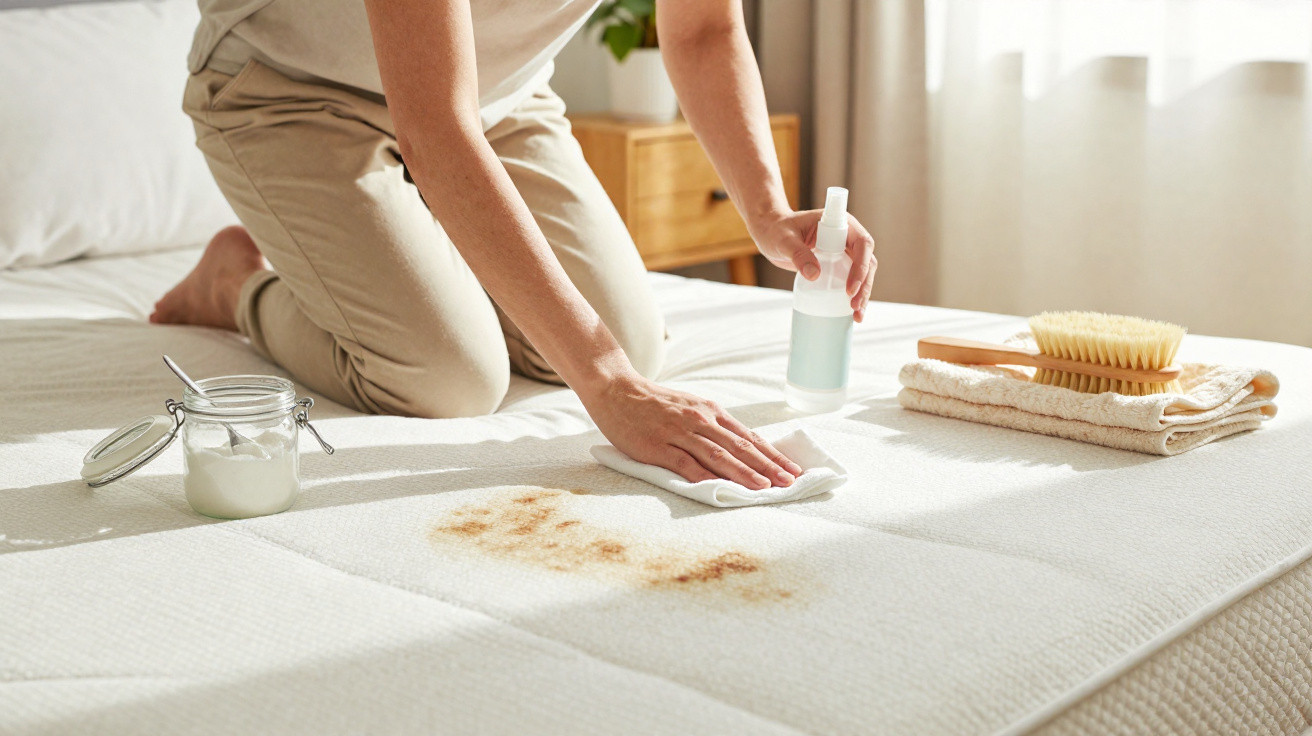
The scene often begins the same way: on a Saturday morning, you pull back the sheet, ready to change the bedding, and find an old stain right in the middle of the mattress.
Yellowed, stubborn, almost staring back at you. It makes no difference whether it came from sweat, a child’s urine, weekend wine or coffee spilled months ago. It is still there, claiming its territory. And you think: “If I soak this in water, it will take two days to dry and smell even worse.”
We have all been there: the moment a supposedly “clean” mattress reveals its secrets at exactly the wrong time. You look at it, pretend you did not see it, cover it with the sheet and promise to deal with it later. But that “later” never comes. Until one day, the light falls differently, the stain appears in HD, and you realise: it cannot be put off any longer. It is time to tackle the problem with a dry cloth. Literally.
There is a way to remove old stains without drowning the mattress, and it is easier than it sounds.
Why mattresses stain so easily – and why soaking them is the worst idea
A mattress is a quiet collector of grime. Daily perspiration, drink splashes, forgotten make-up, saliva and small overnight accidents all build up in invisible layers, until one day a stain seems to have appeared from nowhere. It has not. It has simply had time to oxidise, darken and settle into the fibres. When you add too much water, it travels down into the core of the mattress and remains trapped there, like a damp secret.
That extra moisture creates the ideal environment for mould, dust mites and the sour smell that will not disappear even with the window open. The risk is greater in smaller homes where the bedroom receives little sunlight. The surface may look dry, while the inside remains damp and slowly festers. The plain truth is simple: soaking a mattress is asking for trouble. Its fabric was not designed to be submerged; it needs controlled, almost surgical cleaning.
A quick poll in cleaning and home-organisation groups reveals a curious pattern. Many people still resort to buckets of water, too much soap, aggressive scrubbing, and even a hose. Yet this “wet enthusiasm” nearly always ends the same way: a strong smell, a stain that has spread further, and a quiet sense of regret. When a stain is old, the approach needs to change. You are not merely cleaning the surface; you are breaking down dried, oxidised residue that has already clung to the fibres. That calls for a dry method, patience and the right products, not a mattress bath.
The logic is straightforward, although it is often overlooked: a mattress is not a tiled floor. It cannot drain water, it will not “dry quickly”, and it does not cope well with repeated soaking. When you use excessive water, gravity does what it does best: it draws the liquid down into layers you can no longer reach with a cloth or vacuum cleaner. Removing old stains without soaking the mattress is not fussiness; it is a preservation strategy. It extends the mattress’s useful life, reduces allergies and avoids the endless cycle of cleaning, overwetting, developing an odd smell and having to clean again.
Step by step: removing old stains without drowning the mattress
The first step may feel counterintuitive: before reaching for liquid, think powder. Start by vacuuming the entire mattress thoroughly, paying particular attention to the stained area. Use the upholstery attachment, moving it slowly in crossing strokes as though you were “sweeping from within”. This alone removes dust, dry residue and even some of the oxidised staining, preparing the surface. Next, sprinkle a generous layer of bicarbonate of soda over and around the stain. Do not be timid: cover it properly.
Leave the bicarbonate of soda to work for at least 30 minutes, ideally for 1 to 2 hours. It will help neutralise odours and loosen old particles. Only then should liquid be introduced, and in the smallest possible amount. In a spray bottle, combine 1 part white vinegar with 2 parts water, plus a few drops of mild washing-up liquid. Lightly mist only the stained section until the surface is damp, never saturated. Think mist, not rain. Then repeatedly press clean, dry cloths onto the area, as if you were “drawing” the excess out of the mattress.
The most common mistake is assuming that wetter means cleaner. Let us be honest: nobody does this every day. So, when they finally decide to clean, they want to make up for the delay by overdoing it. That is when the mattress suffers. Cleaning an old stain requires fine, repeated layers of moisture rather than one sudden deluge. Replace the cloth once it becomes very damp. If the stain is organic, such as urine, sweat or old blood, a second treatment using a small amount of 10-volume hydrogen peroxide, applied with cotton wool, may lighten it without wetting the interior. Simply dab it on, wait for it to foam slightly, then dry the area by pressing with a cloth.
For anyone who deals with this regularly, a few sayings tend to come up in behind-the-scenes cleaning conversations:
“A mattress is far too expensive to turn into a laboratory for mistakes involving a bucket of water.”
- Use a spray bottle, not a bucket: this restricts the amount of liquid and distributes moisture more evenly.
- Choose microfibre cloths: they absorb more and help draw dirt outwards.
- Work in small sections: this stops the whole fabric becoming damp at once.
- Keep it ventilated at all times: open the window, point a fan at the mattress, and use natural light whenever possible.
- Repeat rather than overdo it: two or three gentle treatments clean more effectively than one soaking.
When a stain becomes part of the story – and what to do after cleaning
Once you have dealt with an old stain without drowning the mattress, something shifts in your relationship with the bed. You begin to look at that soft rectangle with a little more respect, almost as if it were a family heirloom. Every mark says something about a period of life, a routine, a poor night’s sleep, a child transitioning out of nappies, or wine spilled during a Sunday television series. Some stains disappear almost entirely. Others fade, become discreet and remain as a faint shadow. And that is fine. The aim is not always to restore everything to “as new” condition.
What truly changes the game is what happens afterwards. Fitting a waterproof, breathable mattress protector may sound like an unexciting bedding-shop detail, but it can preserve years of useful life. Making a habit of vacuuming the mattress whenever you change the bedding, even only lightly, already cuts down on the build-up that turns into stains. Small steps, repeated almost automatically, prevent that dramatic Saturday-morning discovery. Cleaning stops being a military operation and becomes straightforward maintenance.
It is also a quiet invitation to take a closer look at the spaces where we spend so many hours each day. Mattresses, sofas and pillows receive nowhere near as much attention as the kitchen floor or shower enclosure, yet they are where the body rests, sweats and breathes. Once you know how to deal with old stains without soaking the mattress, you gain independence, save money and feel a certain relief. Perhaps the next time you pull back the sheet and discover a new mark, it will not come with despair, but with a calmer thought: “OK, I know what to do.”
| Key point | Detail | Value for the reader |
|---|---|---|
| Cleaning without soaking | Using a spray bottle, very little water and absorption with dry cloths | Prevents mould, strong odours and internal mattress damage |
| Layered steps | Vacuuming, applying bicarbonate of soda, then lightly dampening | More effective removal of old stains and odours |
| Ongoing prevention | Mattress protector, regular vacuuming and ventilation | Extends useful life and reduces the appearance of new stains |
FAQ:
- Question 1 Can I use only vinegar and water to remove old mattress stains?
- Question 2 Does hydrogen peroxide stain or bleach mattress fabric?
- Question 3 How long does a mattress need to dry after damp dry-cleaning?
- Question 4 Can an old child’s urine stain really be removed without soaking the mattress?
- Question 5 How often is it worth carrying out a more thorough mattress clean?



Comments
No comments yet. Be the first to comment!
Leave a Comment