
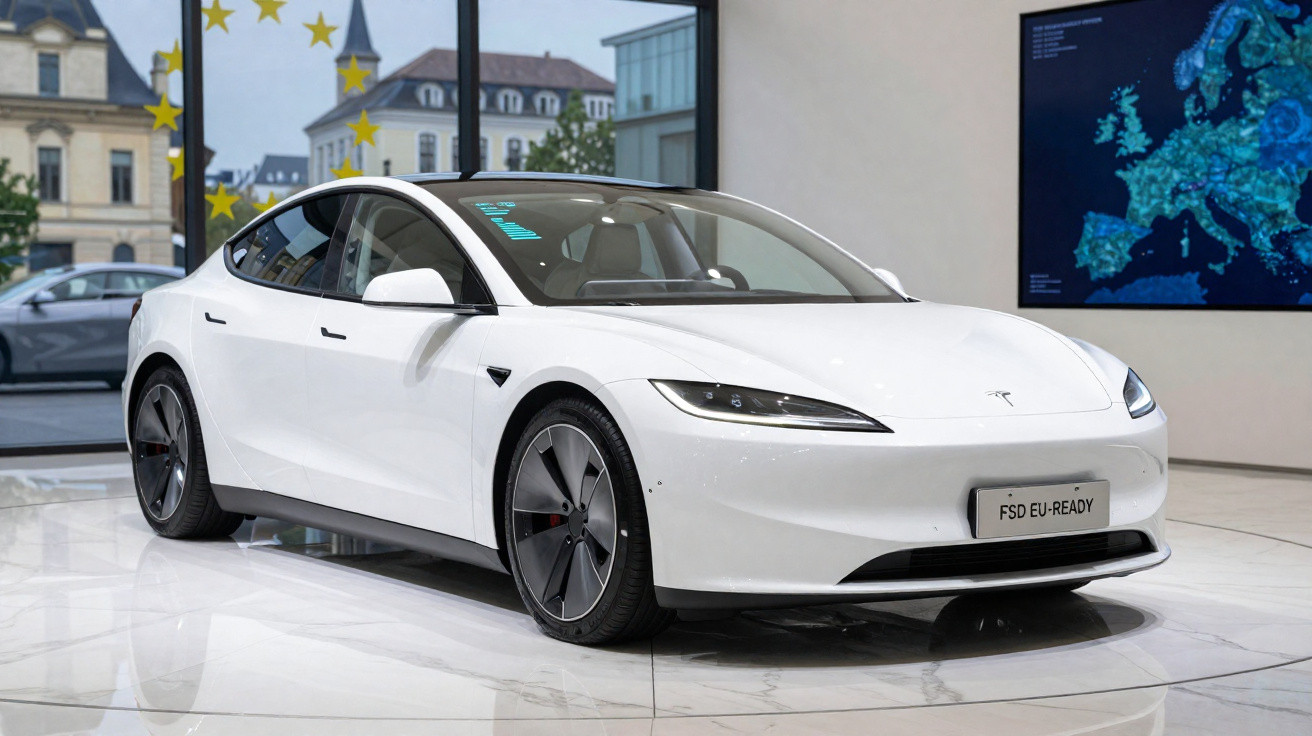
Tesla’s FSD Supervised system, its most advanced driver-assistance technology, is already authorised in five European Union countries. The next stage could prove pivotal: a vote that may extend the approval to every remaining Member State.
Tesla says the vote could take place as early as 6 October, although the date has not yet been confirmed. A source at the French Ministry of Transport told Reuters that the decision could be put to a vote in October or at the beginning of December.
For the proposal to pass, it must secure backing from at least 15 of the 27 Member States, which must together account for at least 65% of the European Union’s population.
What would change?
The issue centres on FSD Supervised, short for Full Self-Driving, which received provisional type approval in the Netherlands in April following more than 18 months of testing by the country’s vehicle regulator, the RDW.
A favourable decision at European level would mean that this approval could be recognised across the other Member States, removing the need for each country to undertake its own separate national process.
If European authorisation is denied, the provisional type approval would subsequently be withdrawn. This would also affect permissions granted in the meantime on the basis of the Dutch approval.
Tesla bolsters its case with new data
With the vote approaching, Tesla has strengthened its case before European regulators. The company released data covering more than 100 million kilometres driven between April and August in the five countries where FSD Supervised is authorised.
According to Tesla, vehicles using the system were involved in three motorway collisions and nine collisions away from motorways. The company’s comparison indicates 137 and 490 collisions, respectively, among manually driven vehicles.
Based on these figures, Tesla says cars fitted with FSD Supervised recorded 4.1 times fewer collisions than those driven manually.
However, the figures are far from universally accepted. Reuters had previously reported that experts questioned the methodology Tesla used in some comparisons submitted to European regulators, arguing that it could give a misleading impression of the system’s safety.
Tesla has also made a public safety-data dashboard available to support approval of FSD Supervised.
FSD Supervised is not 100% autonomous driving
Despite the Full Self-Driving name, FSD Supervised is an advanced Level 2 driver-assistance system.
The car can carry out various tasks, including steering, accelerating, braking and changing lanes, but the driver remains responsible for the vehicle and must stay alert and ready to take control at any moment.
Following the initial approval in the Netherlands, Belgium, Denmark, Estonia and Lithuania also approved FSD Supervised. This brings the number of European countries where the technology - which we have already had the opportunity to test - is currently authorised to five.
France still has reservations
Not every country is persuaded. France and Sweden have expressed reservations about approving the system, although the French government began testing the technology on public roads this week.
The trials are expected to continue until mid- or late September. Their purpose is to validate data submitted by Tesla and the Dutch authorities ahead of a possible European vote.
French Transport Minister Philippe Tabarot had argued that the system should not be approved in its current form because of road-safety concerns. These included speed control and monitoring of driver attention.
In Sweden, one objection also concerns speed, specifically the possibility that the system could allow the car to exceed legal speed limits.



Comments
No comments yet. Be the first to comment!
Leave a Comment