
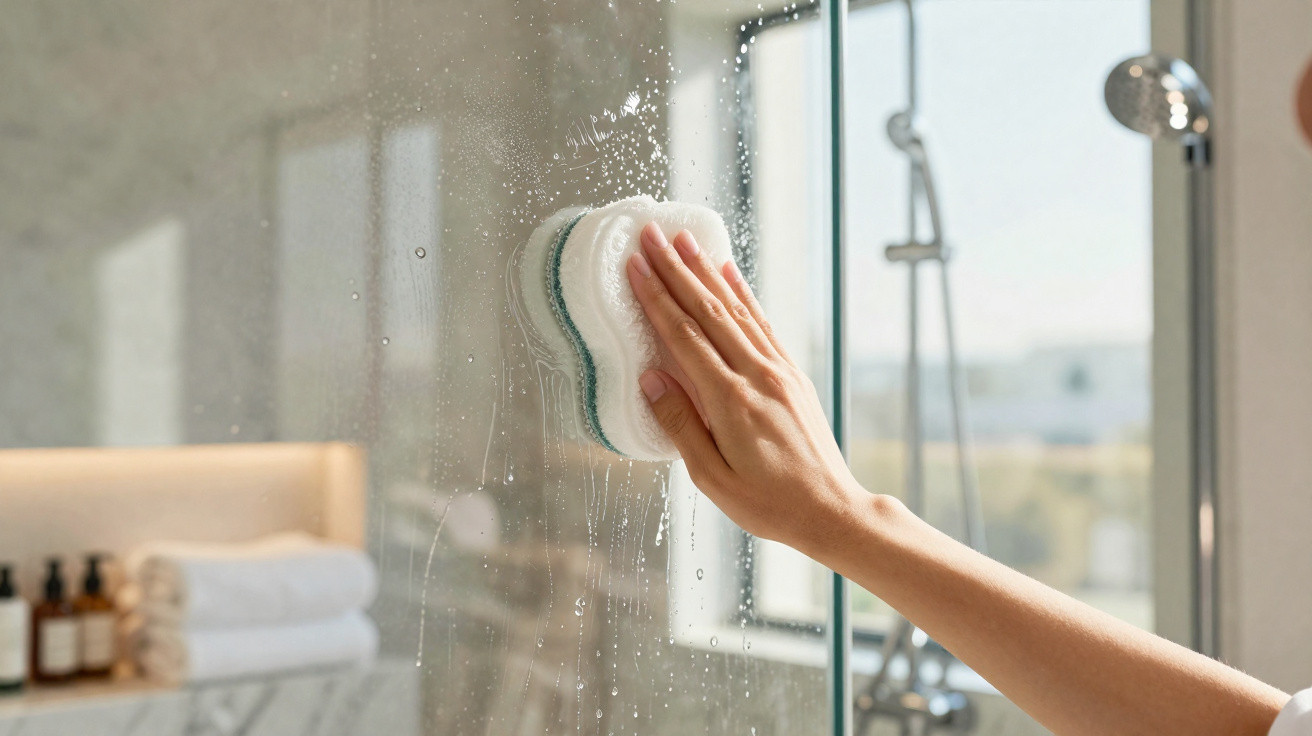
At home, glass shower doors seldom stay looking their best.
Hard-water stains, soap scum and hazy smears can turn transparent shower screens into dull, milky-looking panels. Hotel cleaning staff tackle this same problem every day, but can bring back a “just installed” gleam within minutes. Their approach is notably simple, inexpensive and much less reliant on chemicals than a typical supermarket cleaning cupboard.
Why shower doors stay cloudy however much you scrub
Each shower leaves behind a fine residue. As droplets dry on the glass, they deposit minerals from hard water. Soap and shampoo then attach to these minerals, creating a greasy, pale coating. Given time, this coating becomes difficult to shift and feels rough under your fingers.
This accumulation develops faster in a warm, humid bathroom. Steam leaves surfaces wet for longer, allowing limescale and soap deposits to adhere more strongly. Routine sprays may delay the issue, but once the glass appears etched or misty, scrubbing harder will rarely solve it.
Hotel cleaners deal with extreme limescale and soap scum every day, so any trick they keep using tends to be both fast and proven.
Hotels encounter this issue on an industrial scale, so they cannot afford for staff to spend hours scrubbing. Instead, they use one particular accessory that works rather like exceptionally fine sandpaper on stains, while remaining safe for glass and plastic if handled properly.
The hotel secret: a melamine “magic” sponge
The item that many hotel housekeeping teams rely on is a melamine foam sponge, commonly marketed as a “magic eraser” style product. It appears unremarkable: a small, white, light block with no foaming action or cleaning-product scent.
Its performance comes from its composition. Melamine foam is made from a hard resin which, when formed into foam, creates a web of extraordinarily tough microscopic fibres.
Under a microscope, melamine foam looks like a forest of glass-hard filaments that scrape away grime at a microscopic level.
This is what gives it the effect of ultra-fine sandpaper. As it is rubbed over a surface, every tiny fibre acts as a micro-abrasive. On shower panels, it removes:
- limescale deposits caused by hard water
- soap and shampoo residue
- lingering traces of body oils and cosmetics
- dark staining around seals and plastic frames
Its main benefit is that, with gentle pressure, it removes this layer without producing visible scratches on ordinary shower glass or acrylic panels. This combination of being abrasive enough to work but not damaging is why hotels repeatedly use it.
How to use a melamine sponge on shower doors
The process is straightforward and does not require a mixture of different products. This simple method reflects what housekeeping teams actually do:
- Quickly rinse the shower walls with warm water to clear away loose foam and hair.
- Divide the melamine sponge into halves or quarters, as smaller sections are easier to control.
- Wet the sponge with clean water, then press out the excess so that it is damp rather than dripping.
- Begin at the top of the glass and rub with light, circular movements.
- Give extra attention to cloudy white areas and waterline marks where droplets repeatedly dry.
- Rinse the glass well using warm water, removing the loosened residue.
- Use a microfibre cloth or squeegee at the end to clear any remaining droplets.
You do not need to add chemical cleaner for the sponge to work; water alone activates its abrasive power.
For a heavily stained shower, the initial clean may seem slow. A second clean, generally a few days afterwards, is far faster because the thickest deposit has already been lifted.
Why hotels favour this trick: low cost and fewer chemicals
Hotels continually track two factors: staff time and the cost of supplies. A melamine sponge offers benefits in both areas.
| Aspect | Traditional chemicals | Melamine sponge |
|---|---|---|
| Cost per shower (approx.) | Multiple products, higher spend | Pennies per sponge piece |
| Time needed for tough stains | Long soaking, repeated sprays | Short, targeted scrubbing |
| Chemical exposure for staff | Frequent fumes, irritants | Mainly water, less irritation |
| Environmental impact | Detergents washed into drains | Mostly mechanical action |
The same principle works at home. Generic packs of melamine sponges are cheap, and every block can be sliced into several smaller sections. Before it begins to break down, one small piece will often clean a whole shower enclosure.
There is an environmental consideration too. Using fewer sprays and descalers means fewer surfactants and harsh acids entering the plughole. As it wears away, the sponge does still shed particles similar to microplastics, though at lower volumes than ordinary plastic scouring pads and without the combination of additives present in certain cleaning products.
Where this cleaning hack works best – and where care is needed
A melamine sponge has both advantages and limitations. When used sensibly, it can refresh far more than a shower.
Best surfaces for melamine sponges
- Shower glass and acrylic panels affected by limescale and soap scum
- Plastic shower trays with dark heel marks
- Chrome taps made dull by water spots, provided they are rubbed very gently
- Ceramic tiles and grout with surface dirt
- Mirror edges carrying stubborn drip marks
On these materials, the sponge can help bring back a cleaner, brighter appearance, particularly where sprays no longer seem effective.
Surfaces requiring caution
Since melamine foam is abrasive, rough use can harm soft surfaces or delicate finishes. Avoid it, or carry out an extremely gentle test, on:
- high-gloss painted finishes
- non-stick coatings
- very soft plastics or inexpensive acrylic baths
- tinted glass or glass with a film coating
Always start in an unseen corner, use minimal pressure, and stop immediately if you notice dull patches or changes in shine.
Keeping shower glass clear after restoring it
After tackling the heavy buildup with a melamine sponge, a handful of simple habits can keep shower walls looking hotel-fresh for much longer.
- Run a rubber squeegee over the glass after every shower to remove most water.
- Keep a microfibre cloth nearby and wipe taps and corners once or twice weekly.
- Open the window or operate the extractor fan for 15–20 minutes to lower humidity.
- Give the panels a quick pass with a melamine sponge every few weeks instead of waiting for a thick layer to form.
Water hardness makes a difference as well. In areas with very hard water, limescale develops more quickly, so upkeep may be needed more often. Some homes use a compact water softener or limescale filter to safeguard shower glass as well as kettles, washing machines and boilers.
What “limescale” really is – and why it sticks so firmly
Limescale consists mostly of calcium carbonate and other mineral salts naturally found in tap water. When hot droplets dry on glass, the water evaporates while the minerals remain as chalky, off-white deposits.
Soap scum develops when these minerals react with fats in soap. This reaction explains why the residue can feel oily and gritty at the same time. It binds closely to surfaces, while standard household cloths tend merely to slide across it instead of removing it.
A melamine sponge attacks both parts of the problem: the mineral crust and the soapy film wrapped around it.
This is why conventional approaches using only mild detergent and a soft cloth can be disappointing. They attempt to remove a bonded coating with tools that are simply too gentle. A carefully used micro-abrasive alters that balance enough to release the surface.
When a simple hack transforms your cleaning routine
For many homes, trying it for the first time on an old, hazy shower panel can be a minor revelation. People discover that the glass was not actually “ruined”; it was simply heavily covered. This makes a difference because a shower that visibly looks clean makes the entire bathroom appear fresher and better looked after.
There is a psychological benefit too. What once involved harsh products and lengthy scrubbing can become a brief, almost automatic job. Seeing the improvement on the panels makes you more likely to maintain them with smaller regular cleans instead of putting the task off.
When viewed as a tool rather than a miracle product, the melamine sponge helps explain why hotel showers remain so clear each day. Used at home, this same uncomplicated accessory can make that professional clarity achievable as part of a normal weekly clean.

Comments
No comments yet. Be the first to comment!
Leave a Comment