
Sunlight had scarcely reached across the lounge floor when I spotted it again: a faint grey coating, draped over the wood like a weary veil. It had looked immaculate yesterday. Today, it looked… worn out. I had not made a mess while cooking, nobody had knocked over a plant, and the dog had hardly been outdoors. Yet somehow, the floor had gathered a whole day’s worth of living within just a few hours.
I once assumed the answer was simply to mop more often. To buy stronger cleaning products. To spend more Saturday mornings crouched over a bucket and nursing an aching back.
Then a small adjustment found its way into our routine almost by chance.
And, without any fuss, the floors stopped becoming dirty quite so quickly.
The simple switch that changed everything
The change began on a wet Tuesday, the sort of day when shoes arrive at the front door looking as though they have completed a country walk. My hallway had become a miniature battlefield of shoeprints, muddy droplets and that questionable grit you notice beneath your socks.
That evening, while idly scrolling through my phone, I found another photo of a supposedly “perfect home”. Polished floors. White rugs. The caption mentioned, almost casually, a firm no-shoes policy. I rolled my eyes. I live in the real world, with real people and a dog that forgets his own name.
But the following morning, as I looked at those marked floorboards once more, I wondered whether I needed to go fully Pinterest… or merely take a small step in that direction.
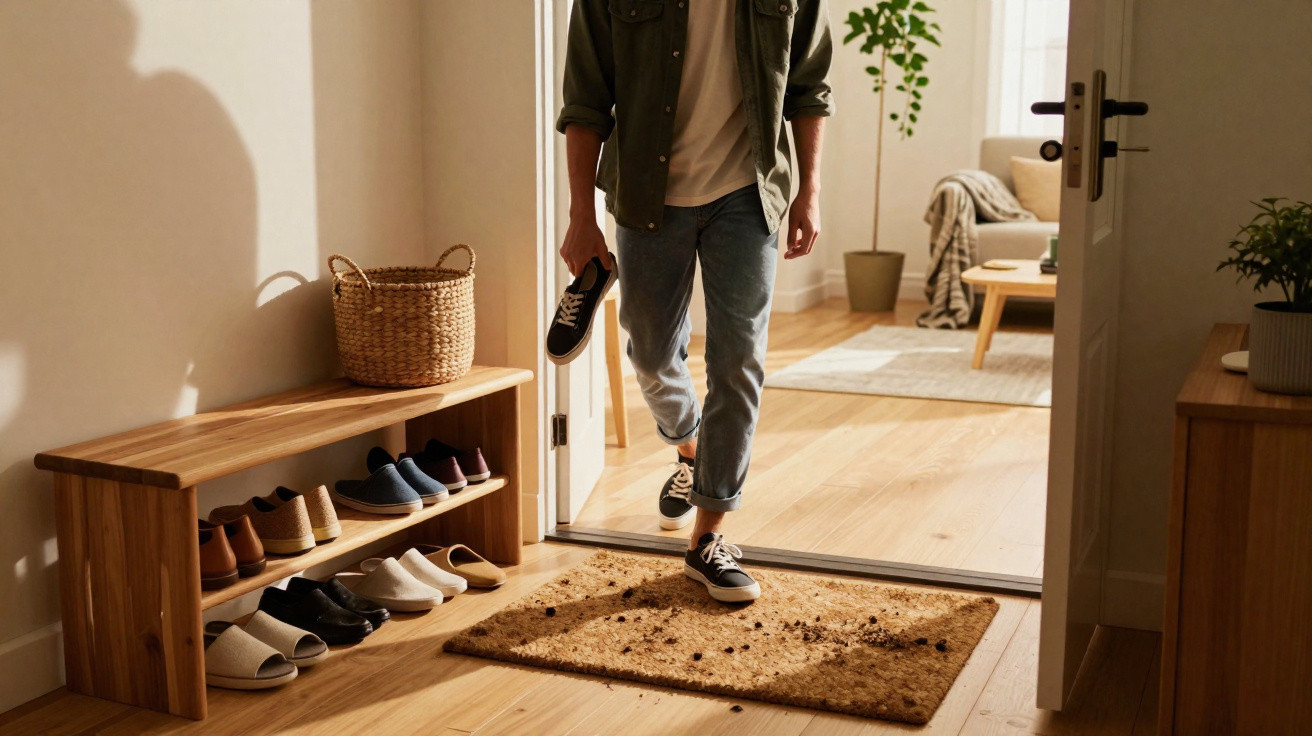
So I tested an almost ridiculously simple idea. By the entrance, I placed a generously sized mat, a low bench and a basket for shoes. I did not announce a household rule or put up a notice. I simply made taking shoes off the most obvious option.
The first few days felt slightly awkward. Visitors paused. My partner forgot. So did I. Even so, shoes gradually began collecting in the basket. Socks and slippers slowly replaced trainers in the hallway. There was no dramatic event and no instant miracle.
Then, roughly a week later, I noticed that I had not felt crunchy grit under my bare feet for days.
Behind that gentle, cosy image of a “shoes off” home is a rather unexciting fact. Most dirt on your floors does not arrive as mysterious dust drifting through the air. It is brought in directly from outdoors, carried on shoe soles and lodged in their treads.
Each step can bring in tiny stones, dry earth, fragments of leaves, oil droplets and all sorts of unseen urban residue. Those small particles are then spread about, scuffed into the floor, crushed and smeared, particularly in the most frequently used parts of the home. That is why floors can lose their shine so quickly, even shortly after cleaning.
Stop that flow at its starting point, and the entire calculation shifts.
How to make “shoes off” feel natural, not strict
The key is not really the rule. It is ensuring that the preferred choice is also the easiest one. The less willpower a habit needs, the longer it lasts.
Rather than seeing it as a rule, I began treating it as a question of layout. I positioned a small bench beside the door so nobody had to balance unsteadily on one foot. A thick, washable rug catches the first few steps. A basket sits exactly where your hand naturally reaches when you bend down.
Then I added the real secret weapon: something comfortable to put on instead. Slippers during winter and soft house socks in summer. All at once, taking shoes off no longer seemed like a penalty. It felt like arriving home.
If you share your home with children, flatmates or a partner who seems convinced that floors clean themselves, you will know that altering a shared routine is gradual and a little irritating. Small signs achieve nothing. Nagging certainly does not help.
It works better when it feels like an invitation rather than an instruction. Place children’s slippers where they can easily reach them. Make the mat large enough that people do not need to step onto a clean floor in outdoor shoes. When visitors arrive, a warm “We’re kind of a shoes-off house, want some slippers?” will generally do the trick.
In truth, nobody follows this every day with military precision. On some hectic mornings, the habit vanishes. That is perfectly all right. The aim is not flawlessness; it is to turn the daily surge of dirt into a small trickle.
One friend told me, “I thought your place just magically stayed clean. Then I saw the mini mountain of sneakers by the door and went home to copy it.”
- Start with one entrance
If your home has more than one door, choose the one used 80% of the time. Concentrate on that entrance before attempting to manage every possible way in. - Create a “landing strip” zone
Include a mat, a bench or chair, plus a clearly visible basket or shelf. The more defined this small area is, the less disorder travels into the rest of the home. - Give shoes an obvious home
Shoes tend to stray when they have no designated place. A basic rack, crate or low shelf near the door keeps the arrangement effortless. - Reward the habit with comfort
Keep your softest socks or cosiest slippers right there. Replacing outdoor shoes with something warm can feel like a small everyday treat. - Stay flexible on busy days
There will be days when you hurry through with shopping or visitors. Do not turn that into guilt. Doing this most of the time will still keep floors cleaner for far longer.
What happens when the dirt stops at the door
Once outdoor dirt stopped confidently making its way through my hallway, the outcome was almost mundanely practical. I moved from vacuuming every other day to doing it once or twice a week, without feeling as though I was “letting things slide”. The floors simply remained bright for longer.
The familiar film near the kitchen or in the lounge took much longer to develop. That slightly tacky feeling around the dining table no longer built up as quickly. Even mopping became simpler because I was not fighting through layers of ground-in grit.
There was also an unexpected benefit: the air seemed fresher. There was less fine dust, fewer unexplained crumbs beneath the sofa and fewer stray specks clinging to bare feet at night.
| Key point | Detail | Value for the reader |
|---|---|---|
| Limit outside dirt at the door | No-shoes zone + good mat + shoe spot | Floors stay visibly clean up to twice as long |
| Create an easy routine | Bench, slippers, clear storage | New habit feels natural, not like extra work |
| Accept “good enough” consistency | Most days, not all days | Cleaner home with less guilt and less effort |
FAQ:
- Question 1 Do I really need a strict no-shoes rule for this to work?
- Answer 1 No. Even asking people to wipe their shoes well on a sturdy mat or removing shoes on rainy days cuts a big chunk of incoming dirt and extends the time between cleanings.
- Question 2 What kind of mat makes the biggest difference?
- Answer 2 Look for a heavy, textured mat that scrapes soles rather than a thin, pretty one. Coir, rubber-backed mats or tough washable rugs near the door trap far more grit.
- Question 3 My family keeps forgetting. How do I keep this going?
- Answer 3 Adjust the setup, not the people. Move the bench closer, add a bigger basket, keep slippers more visible. The easier it is physically, the less anyone has to “remember”.
- Question 4 What if I have guests who are uncomfortable taking off their shoes?
- Answer 4 Offer options without pressure: disposable shoe covers, clean socks, or a friendly “no worries” if they prefer to keep shoes on. Your daily habits matter more than one evening.
- Question 5 Will this help with allergies or dust too?
- Answer 5 Yes, cutting outdoor dirt and pollen at the entrance means less fine dust circulating indoors, which often makes floors, furniture and even the air feel cleaner longer.

Comments
No comments yet. Be the first to comment!
Leave a Comment