
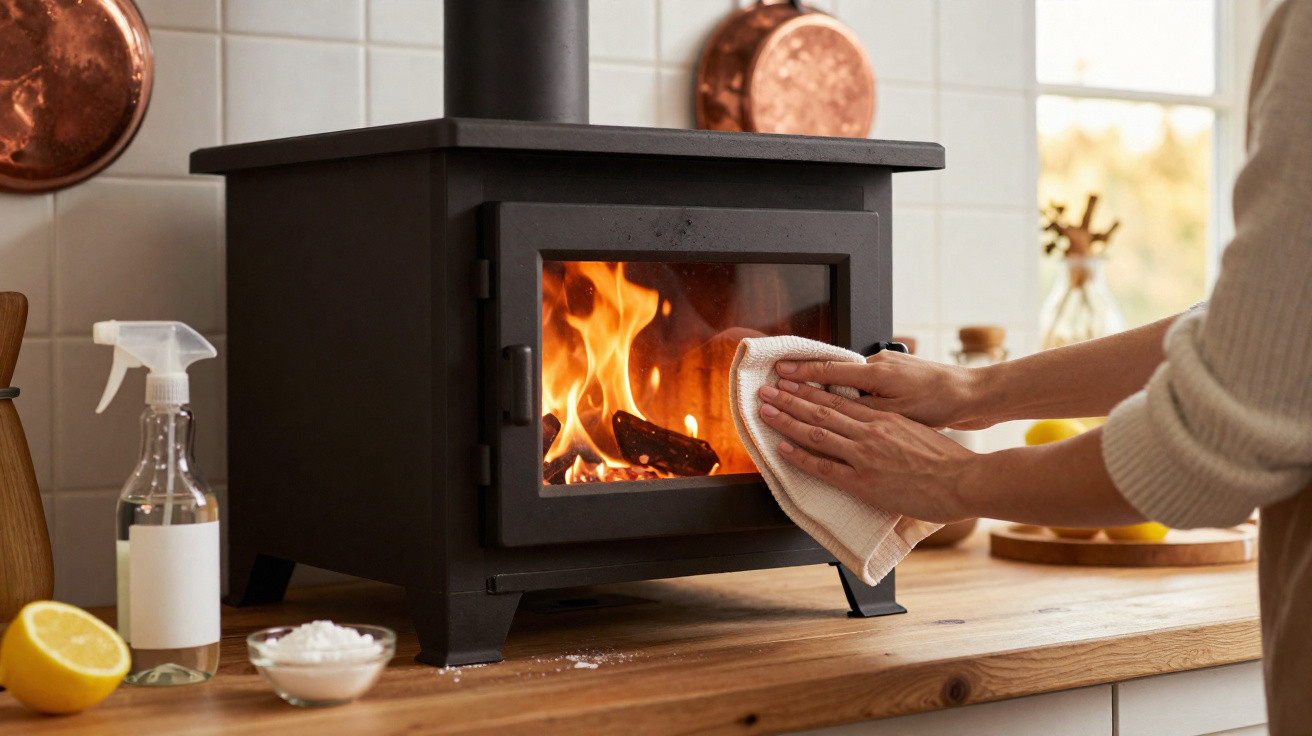
A straightforward household remedy can make this problem almost disappear on its own.
Many wood-burning stove owners will recognise the issue: after only a few evenings, the glass door is so blackened with soot that the flames are barely visible. Ash is often recommended as the traditional solution – and it does work, but it is messy and inconvenient. There is a faster, cleaner and remarkably effective alternative that few people know about, using items most households already have.
Why wood-burning stove glass turns black so quickly
Understanding what causes soot to build up on the glass makes it easier to prevent. In most cases, several factors are involved.
- Poor-quality or overly damp wood: Damp logs produce substantial smoke, creating more soot particles that settle on the inside of the glass. Wood with a residual moisture content below 20 per cent is ideal.
- Incomplete combustion: If the fire receives too little oxygen or the combustion chamber does not become hot enough, gases cannot burn completely. As a result, soot settles on the glass pane.
- Incorrect air supply: When the primary air intake is restricted too much, the fire effectively becomes starved of air. The flame darkens and the glass changes from dark grey to black.
- Continual low-output operation: Many people turn their stove right down to save wood. Although this may seem tempting, it produces a smouldering flame and far more deposits.
Clean, dry wood and enough air are half the battle when it comes to keeping stove glass clear.
The secret trick: cleaning stove glass with kitchen ingredients instead of ash
Rather than getting your hands dirty with ash, you can clean the glass using two basic household products: clear household vinegar and bicarbonate of soda, or baking powder. Together, these products react and break down stubborn soot layers surprisingly quickly.
Why this combination works so well
- Household vinegar breaks down grease and grime: It softens black deposits and also dissolves the slightly oily residues created during burning.
- Bicarbonate of soda provides mild abrasion: Its fine crystals create a gentle scouring effect, lifting soot and baked-on dirt without scratching the glass.
- The reaction helps shift the dirt: When vinegar meets bicarbonate of soda, it fizzes. This movement helps loosen particles from the pores and corners of the glass.
Step by step: how to make wood-burning stove glass crystal clear again
Step 1: Prepare the mixture
Before starting, make sure the stove has cooled down completely. The glass must be no more than hand-warm.
- Pour two parts vinegar into a small bowl.
- Add one part bicarbonate of soda.
- Wait briefly for the mixture to fizz a little.
For a more convenient approach, put the vinegar in a spray bottle and sprinkle the bicarbonate of soda directly over the wet glass. The cleaning result is the same.
Step 2: Apply the solution and leave it to work
- Dip a soft cloth or sponge into the mixture.
- Work over the glass in circular motions, moving from top to bottom.
- Apply a thicker layer to heavily sooted patches and allow it to sit briefly.
In most cases, the soot layer begins to lift after just a few strokes. Very old, baked-on deposits may require two applications.
Step 3: Remove residue and polish
- Wipe the glass with a clean, slightly damp cloth until every trace of residue has gone.
- Finish by polishing with a dry microfibre cloth so that no streaks remain.
Vinegar and bicarbonate of soda can often make stove glass transparent again in less than a minute.
Natural alternatives if you do not have vinegar or bicarbonate of soda
If there is no bicarbonate of soda or vinegar in the house, other useful options are often already in the cleaning cupboard.
- Black soap: A small amount on a damp sponge gently removes grease and the soot film. It is particularly suitable for light to moderate dirt.
- Rubbing alcohol: Applied with a cloth, it quickly removes oily residues and thin layers of soot. It is a good choice for a quick in-between clean.
- Hot water and newspaper: This is a classic method: dip a scrunched-up piece of newspaper in hot water and rub the glass with it. It works best on fresh dirt that has not yet baked on.
How to significantly reduce fresh soot on the glass
Anyone wanting to clean less often should improve the way the stove is used. Even small changes can make a visible difference.
Choose the right fuel
- Use dry hardwood: Beech, oak and ash burn hotter and more cleanly than soft coniferous woods. The glass therefore stays clear for longer.
- Store wood correctly: Leave it to dry for at least two years in a well-ventilated, rain-protected place, ideally with air circulating around all sides.
Set up and use the stove properly
- Allow enough air: During lighting, open the air supply fairly generously so a bright, lively flame can develop.
- Avoid prolonged smouldering: Do not run the stove at a very low setting for hours. Short periods at a higher output burn soot and gases more effectively.
- Let the stove burn hot regularly: Every so often, run the stove hot for a few minutes. This reduces deposits in the combustion chamber and on the glass.
Clean consistently while dirt is still fresh
A quick weekly wipe over the glass with vinegar and bicarbonate of soda prevents thick, hard layers from forming. Fresh soot comes away very easily, whereas old deposits require considerably more effort.
Everyday benefits of natural cleaning
Many specialist cleaners sold in shops contain harsh chemicals. They can damage stove seals, irritate the skin and airways, and place a burden on the environment. Vinegar and bicarbonate of soda are different.
- Gentle on glass and seals: Provided it is left on only briefly and wiped away thoroughly, the mixture does not attack either the safety glass or rubber seals.
- Low cost: A litre of vinegar and a packet of bicarbonate of soda cost only a few pounds and will last for many cleaning sessions.
- No pungent chemical smell: The familiar vinegar scent disappears after a short time, leaving no harsh residues behind.
Practical tips and small pitfalls
A few points will help ensure the cleaning process goes smoothly:
- Never clean the stove while the glass is still hot, as there is a risk of burns and, in extreme cases, thermal stress cracking.
- Do not use wire wool or sharp scrapers directly on the glass, to avoid scratches.
- Remove ash from the firebox first, so grey dust does not blow back onto the glass while you are wiping it.
Once people have tried this method, they rarely go back to harsh sprays. Especially in homes with children or pets, choosing vinegar and bicarbonate of soda offers reassurance because no irritating fumes are produced. When combined with sensible stove operation, the glass stays noticeably cleaner for longer – and watching the fire becomes enjoyable again rather than a reminder of household chores.






Comments
No comments yet. Be the first to comment!
Leave a Comment