
It is Saturday morning, the sun is casting low light across the kitchen tiles, and you think, “Today I’m going to give the floor a proper mop.” The bucket is filled in moments, you add a splash of cleaner, soak the cloth, give it a quick squeeze and get started. After the first few passes, the floor shines and you feel pleased – until you return a few minutes later to find streaky puddles everywhere. The children slip about, the dog leaves paw prints through the damp mess, and you wonder why mopping so rarely feels properly clean. We all know that moment when it becomes clear: we are doing something wrong. The surprising answer lies in a gesture that seems insignificant. One grip, one twist – and the entire floor is far too wet.
Why your mopping cloth puts more water on the floor than you realise
Watch people cleaning in flats, offices or communal hallways and the same routine appears again and again: cloth into the bucket, a brief squeeze, a half-hearted twist, then straight back to the floor. Their hands are free again quickly, the cloth is still dripping slightly, but “it will dry soon”. The trouble is that this “soon” takes ages. Rather than cleaning, you are moving dirt and diluted cleaner across a layer of water. If you are unlucky, the surface feels stickier afterwards than it did before. This is precisely the point at which you either mop properly or simply create a paddling pool.
Picture a caretaker who cleans ten corridors every day. She immerses the mop, puts it into the press, applies firm pressure and gives it one final twist. Her floor can be walked on within a few minutes, with no smearing. Now compare that with your last attempt at home: a textile mopping cloth, briefly wrung by hand, and a bucket without a press. Ten minutes later, the surface looks as though it has just rained. A small study by a cleaning-products manufacturer found that many people cleaning at home leave up to 40 percent of the water in the cloth, while professionals reduce this to under 15 percent. It may sound like a dry detail, but it explains very clearly why your floor takes so long to dry again.
The difference comes down to pressure, angle and the order of the movements. If you merely squeeze the cloth together, you mainly compress its centre. The fibres around the edges remain saturated. As soon as you pull the cloth across the floor, that water runs straight out onto it. Pressing and twisting, by contrast, spreads the pressure more evenly. Water is drawn from all the fibres, not only those in the middle. Let’s be honest: nobody does this every day with the patience of a trained cleaner. Yet this overlooked technique is exactly what turns a mopping cloth into a useful tool rather than a slippery invitation to fall over.
The correct wringing technique: a small trick with a major effect
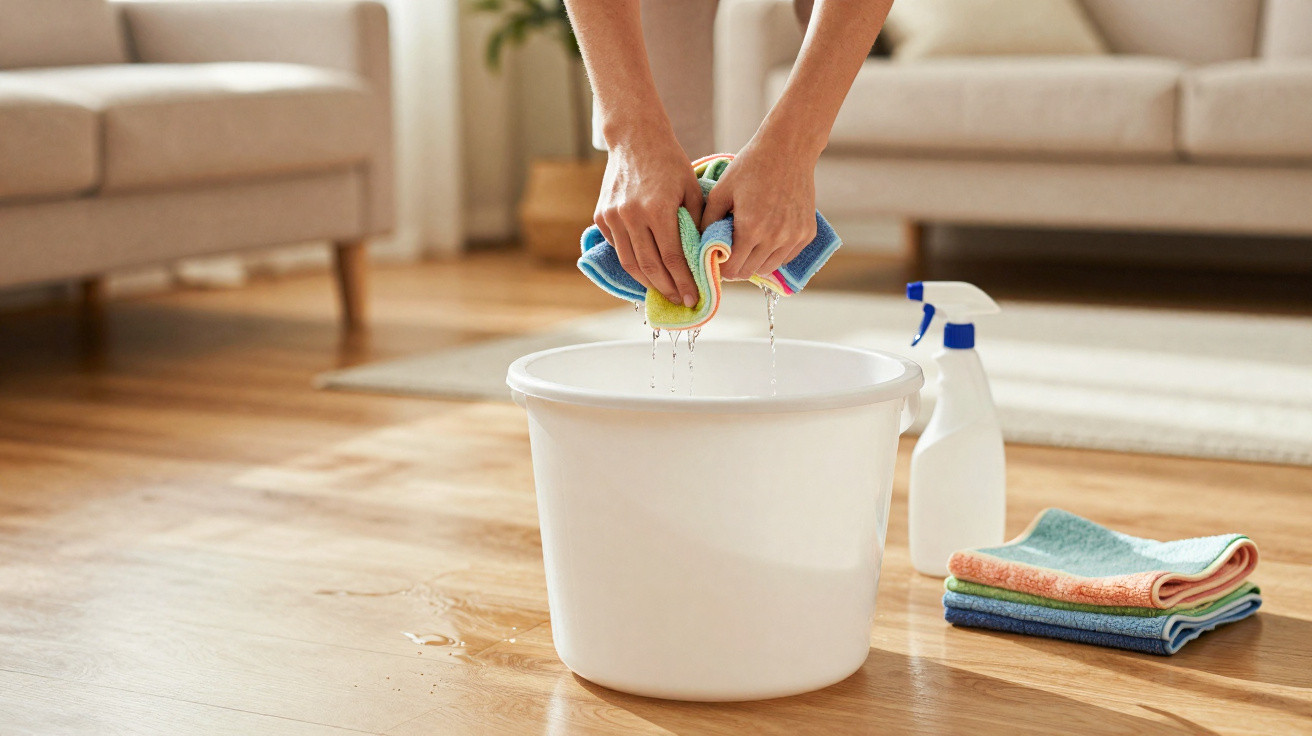
The key is a movement that may seem almost old-fashioned: genuinely wring the cloth instead of simply squeezing it. First, submerge the mopping cloth fully in the bucket and let it absorb the water. Then lift it out with both hands and hold it over the bucket, rather than carrying it dripping around the room. Hold each end so that they hang down parallel to one another. Now comes the stage most people cut short: pull your hands in opposite directions, as though you were twisting a wet washing line. Start gently, then twist more firmly until the fabric feels slightly thinner. At that point, most of the excess water has been removed – and your floor will later be only lightly damp rather than wet enough to float on.
Many people stop after the first half-turn. Their hands slip, the water is cold, and they simply want to get on with the job. There is often a small worry, too: “If I wring it too hard, the cloth will be too dry and the dirt will stay stuck.” In fact, the opposite is true. An overly wet cloth dilutes dirt and spreads it into a film. A well-wrung, damp cloth picks up dirt instead of pushing it around. Anyone with sensitive hands can use rubber gloves or a simple press, but the principle remains unchanged: spend two more seconds wringing rather than ten more minutes waiting for the floor to dry and mopping again.
“The ideal time to stop is when water no longer runs from the cloth in streams and only individual drops remain,” explains an experienced building cleaner I met in a Berlin office block. “Many people expect the cloth to still be dripping wet. That is exactly where the problems begin.”
- Submerge the cloth completely, rather than merely dampening it – only then can dust and grease really be released from the fibres.
- Always wring it out over the bucket, never over the floor – it sounds obvious, but it prevents invisible trails of water.
- Keep twisting until only drops emerge, rather than thin streams of water – that is your internal signal to stop.
- It is better to rinse and re-wring more often than to clean an entire room with a cloth that is too wet and dirty.
- For parquet and laminate, press the cloth briefly into a dry towel once more – this extra movement can prevent the flooring from swelling.
Why an almost dry mopping cloth makes your living room quieter
Anyone who consciously listens while mopping will quickly notice the difference. A cloth that is too wet makes a squelching, slurping sound and leaves that faint sticky noise as you pull it over tiles or laminate. A properly wrung cloth glides much more quietly; you hear only a soft scrape, almost like a broom on a smooth floor. That sound is more than an acoustic detail – it is a small indication of how much water you are applying. You suddenly realise that mopping is not simply cleaning, but almost a minor technical exercise. Once you have experienced it, you may wonder how naturally you used to drag whole bucketfuls of water around your home.
| Key point | Detail | Benefit for the reader |
|---|---|---|
| Reduce the water in the cloth | Twist in opposite directions with both hands until only drops come out | Dries faster, creates fewer streaks and reduces the risk of slipping |
| Rinse more frequently | It is better to dip briefly into the bucket and re-wring more often than continue with a dirty cloth | Dirt is genuinely removed rather than spread around, and the floor feels clean for longer |
| Consider the flooring material | For wood and laminate floors, wring the cloth even drier or press it in a towel afterwards | Protects against swelling and marks, extending the floor’s lifespan |
FAQ:
Question 1: How damp should a mopping cloth ideally be?
It should feel distinctly damp without dripping. If you hold it briefly over the bucket and no continuous stream comes out, only individual drops, it is in a good range.Question 2: Do I need to buy a special mopping cloth?
Not necessarily. Microfibre cloths absorb plenty of water and also release it well, while cotton cloths are more robust and familiar. More important than the material is how you wring it out and how often you rinse it during mopping.Question 3: Why does my floor feel greasy after mopping?
Usually, the cloth is too wet or too dirty. The cleaner becomes overly diluted, dirt loosens and then remains behind as a film. A clean, properly wrung cloth and slightly less cleaner often make an enormous difference.Question 4: How often should I rinse the mopping cloth in the bucket?
At the latest, do so when you can see slightly grey or brown water running from the edge of the cloth. In heavily used rooms, this may happen every few square metres; in cleaner areas, somewhat less often.Question 5: Is a mop press really better than wringing by hand?
For larger areas, yes, because it distributes pressure more evenly and is kinder to your hands. At home, hand-wringing is usually sufficient, as long as you twist thoroughly and allow yourself those extra few seconds.
Comments
No comments yet. Be the first to comment!
Leave a Comment