
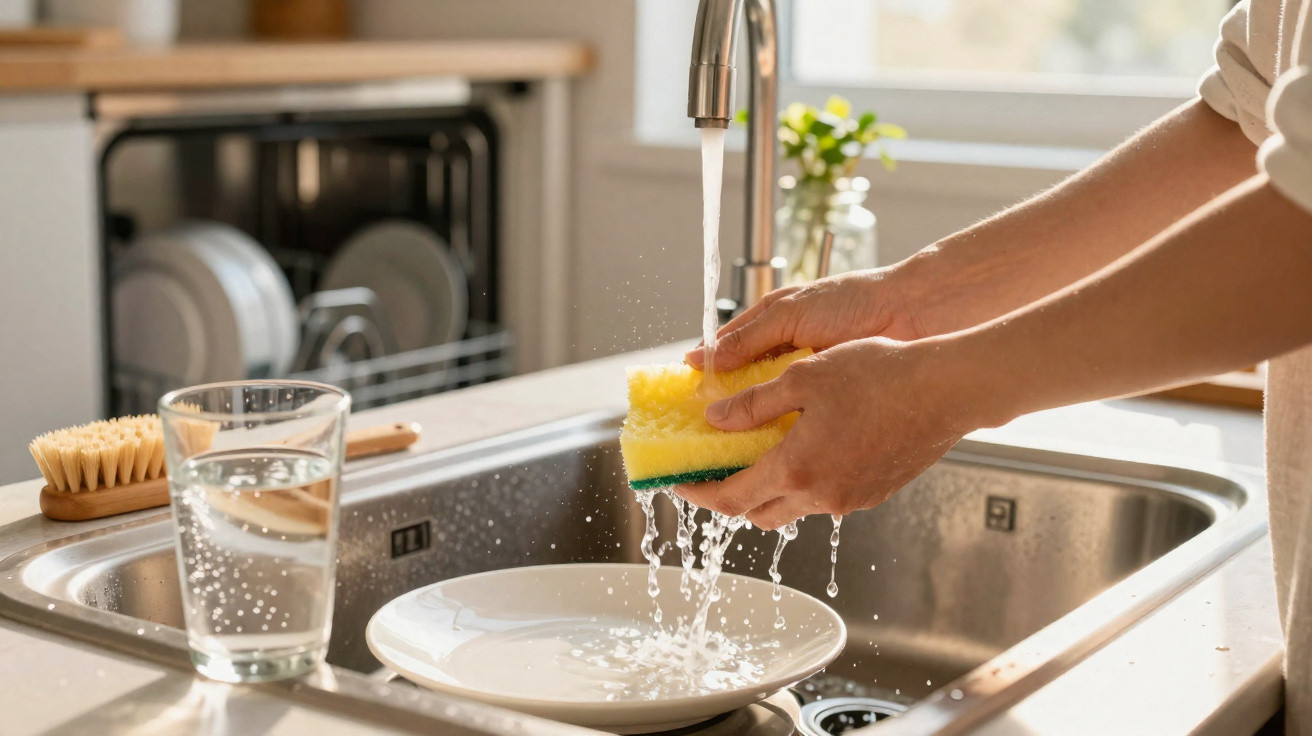
Most of us barely notice the sponge beside the sink, yet fresh research indicates that it contributes more to pollution than previously assumed.
Researchers discovered that routine dishwashing can send minute plastic particles from sponges into wastewater, although certain varieties shed substantially more than others.
The research also identifies a larger source of environmental impact: how much water is used while washing up. Taken together, the results redirect attention from simply the products we choose to the way we use them.
Sponge wear in the sink
In volunteer households, three widely used sponge designs showed obvious surface wear after everyday use in kitchens.
Using these worn domestic sponges, University of Bonn researchers demonstrated that models containing more plastic discharged considerably more material down the drain.
This difference remained even where two European sponges lost a similar amount through wear, as the version containing 59.3 percent plastic released much more material overall.
Wear by itself therefore did not account for what entered wastewater, making the composition of the material the next factor requiring closer scrutiny.
How sponges shed microplastics
When worn material rinses away from a sponge, it becomes microplastics: tiny pieces of plastic produced during ordinary scrubbing.
Each pass over a plate or worktop generates friction that gradually removes particles and fibres. More vigorous scrubbing results in greater release.
However, sponges do not all perform alike. Their layers differ, and plastic represented only 15.9 percent of the organic sponge, compared with 59.3 percent in one conventional model.
This variation explains why sponges may deteriorate at comparable speeds while releasing sharply different quantities of plastic.
Real kitchens, real results
To establish what occurs in practice, the researchers needed to move beyond laboratory conditions and study actual kitchens.
People wash up differently: some scrub more forcefully, others rinse for longer, while some retain sponges for weeks and others discard them quickly.
The team therefore used citizen science, distributing sponges to volunteer households. Participants weighed the sponges before and after several weeks of use, while recording information including rinsing routines, detergent use and the time spent washing up each day.
This real-life evidence recorded an aspect that laboratory experiments often overlook: the way ordinary habits influence wear and deterioration.
Machine versus real dishwashing
In the laboratory, the researchers used a machine named SpongeBot to separate the effect of purely mechanical wear.
The apparatus repeatedly compressed wet sponges underwater, replicating a scrubbing action without food residues or differences in human behaviour.
The greatest material loss occurred early on, during the first few hundred cycles. This indicates that new sponges may shed most heavily at the start of their usable life.
Nevertheless, even SpongeBot could not entirely reproduce the untidy conditions of a kitchen sink, which made the household findings especially valuable.
Water use drives impact
When the researchers calculated effects over the complete life of each sponge, water consumption outweighed almost all other factors.
Their life cycle assessment, which totals a product's overall impacts, concluded that water was responsible for roughly 85 to 97 percent of ecosystem damage.
Hand washing involves water treatment, sewage processing, pipe infrastructure and energy, meaning every additional minute with the tap running increases the impact.
The results did not absolve sponges of responsibility, but they moved the most influential action from purchasing choices to washing behaviour.
Small bits, big problem
For one person, the figures appear modest. Depending on the sponge type, each individual releases approximately 0.57 to 4.25 g of sponge-derived microplastics annually.
Once extrapolated, however, these small quantities rapidly accumulate. In Germany, they equate to around 63 to 391 tonnes each year before wastewater treatment removes most of the material.
Although about 90 percent is captured, several tonnes still reach freshwater environments or agricultural soils annually. A single sponge may seem unimportant, but the combined effect is far from trivial.
Microplastics beyond sponges
A recent review of kitchen utensils found that items other than sponges also release plastic, expanding the picture of household sources.
Plastic chopping boards may shed an estimated 7.37 to 50.75 g per person every year, considerably exceeding sponge totals.
A World Health Organization report has observed that people also encounter these particles through food, water and air.
Against this wider context, sponge design still warrants consideration, even though the kitchen sink is not the greatest source.
Organic isn’t always better
One finding challenges simple marketing claims: the sponge marketed as organic did indeed release the least plastic. Its lower plastic content of 15.9 percent helped keep annual emissions close to 0.57 g per person.
However, the paper also noted that polymers degrade in different ways, meaning that lower mass does not necessarily equate to less harm in every environment.
People seeking a flawless green label will not find one in these results, only trade-offs that merit more careful consideration.
Simple ways to reduce impact
The most straightforward lesson starts at the tap, well before a sponge is placed in the sink.
Reducing running water immediately lowers the largest environmental burden by decreasing treatment requirements before sponge materials become relevant.
Meanwhile, selecting sponges with less plastic and keeping them in use for longer can reduce manufacturing impacts and limit the material lost through wear.
Together, these decisions present a broader understanding of sustainability, taking account of both daily routines and the materials we depend upon.
The outcome is a straightforward yet significant trade-off: tiny fragments are shed from a sponge's surface, while larger environmental costs come from the running tap.
Although future studies may adjust the precise figures, the central message is already evident: use less water and buy less plastic.


Comments
No comments yet. Be the first to comment!
Leave a Comment