
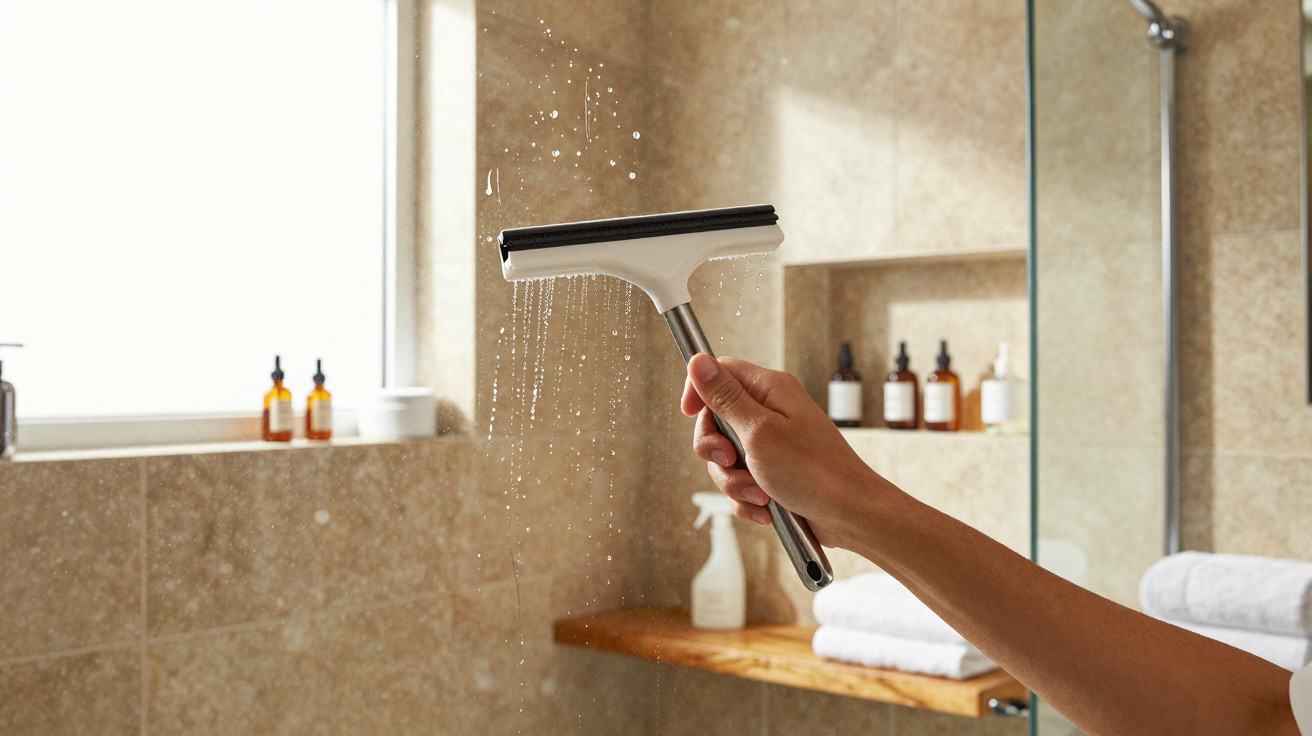
The shower screen gleams: no limescale marks, no water spots, not even that small line along the bottom rubber seal. You run a hand across the glass and wonder: how do they manage this across dozens of rooms every day? As you stand in the shower, your own bathroom comes to mind. The half-hearted deep clean on Saturday, the cheap glass cleaner, the shower squeegee you had “meant” to use every time. Let’s be honest: nobody actually does it daily. Yet hotel glass still looks brand new. The secret is far less dramatic than you might expect – and that is precisely what makes it so effective.
Why shower screens at home quickly lose their shine
We all know that moment when the morning sunlight hits the bathroom at exactly the right angle to expose every mark. All at once, it is no longer just glass, but an archive of toothpaste splashes, limescale edges and dried droplets. Under the artificial light the night before, it had looked “good enough”. Now it looks more like “I only clean when visitors are coming”. By comparison, a hotel bathroom seems like another world: a crystal-clear shower screen, no streaks and no shadows. Quietly, you think: there must be a better approach than my spray-and-wipe chaos.
A professional cleaner I spoke to described a simple comparison. They set up two identical bathrooms side by side. One was cleaned with standard glass cleaner alone. In the other, they used the “hotel trick” that many establishments discreetly build into their cleaning schedule. After two weeks, the first shower screen looked like one in an average rented flat. The second? It still looked almost as good as it had on day one. No magic and no specialist coating costing hundreds of pounds. Just a process that takes five minutes to learn – and is almost cheekily straightforward.
The practical reason is not particularly glamorous: water spots are simply dried tap water, along with everything dissolved in it – especially limescale. When droplets remain on the glass, so do the minerals. With every shower, another slight layer builds up. What looks so flawless in a hotel is simply consistency backed by a system. Rather than fighting a cleaning battle once a month, a tiny step is added after every use. That is the real game-changer at home.
The hotel trick for shower screens: how professionals protect the glass
The essential first step of the hotel trick happens immediately after showering. Not ten minutes later, and not “when I remember again”. While the shower screen is still warm and wet, use a simple rubber squeegee. There is no need to press hard or strive for perfection; simply pull it from top to bottom, section by section. A head housekeeper at a four-star hotel told me: “Our staff need around 30 seconds to do this in a room.” Any remaining water is then gently dabbed away with a microfibre cloth. There is no scrubbing involved; it is more like drying spectacles. This removes any opportunity for droplets to turn into marks in the first place.
The second part may initially sound like extra work, but it saves a great deal of frustration later. Once a week – rather than every day – use a mixture of lukewarm water and a little clear vinegar. Combine them 1:1 in a spray bottle, lightly spray the shower screen, leave it for two minutes, spread it with a soft sponge and rinse. If you have delicate silicone seals, avoid the edges. Many people struggle less with cleaning itself than with a mistaken assumption: they believe harsh, aggressive cleaners will get the job “done faster”. In reality, these can damage the glass and seals, making the surface rougher – and allowing limescale to cling even more readily.
“We treat shower screens as sensitive surfaces, not like encrusted baking trays,” a head housekeeper told me with a laugh. “The gentler we are, the longer they stay like new.”
- Prevention beats scrubbing: A quick squeegee after showering is more effective than monthly cleaning sessions.
- Vinegar water rather than harsh chemicals: Gentle acid removes limescale without punishing glass and seals.
- Use soft microfibre cloths: They leave fewer streaks than kitchen roll or old cotton cloths.
- Never use scouring pads on glass: They roughen the surface and make it more prone to stains over time.
- Keep the routine smaller than the excuse: If it takes under two minutes, it is far more likely to fit into everyday life.
Turning a cleaning trick into a quiet touch of luxury
It becomes interesting when you view the hotel trick not as another irritating chore, but as a small ritual. Many people I spoke to said the same thing: “Since I started doing it straight after showering, my bathroom feels different.” It is that brief moment when you squeegee the screen and realise that the gradual mess is not building up again. Your future self will not have to spend an hour on their knees scrubbing three weeks later. Instead, they get a bathroom that feels almost like being on holiday – just with your own towels.
We all know a bathroom that looks lived in. Toothbrushes, half-full shampoo bottles and a disposable razor still lying somewhere. But when at least the shower screen is clear, the room suddenly appears larger, brighter and more orderly. That visual calm is more than decoration. It takes some of the pressure out of the morning. You do not begin the day with the nagging thought, “I really ought to do that again…”, but with a clear view. Once you have seen how a streak-free glass screen transforms an entire bathroom, it is difficult to go back to “it will do”.
The plain truth remains: nobody has time to maintain perfect hotel standards throughout the whole home. That is exactly why this one small trick is so powerful. A rubber squeegee beside the shower, a microfibre cloth within reach and a vinegar spray bottle in the cupboard are all you need for a shower screen that continues to look new. Perhaps it offers something else, too: the feeling of bringing a little quiet hotel comfort into everyday life, without having to stay away from home.
| Key point | Detail | Benefit for the reader |
|---|---|---|
| Consistent water removal after every shower | 30 seconds with a rubber squeegee, working from top to bottom | Prevents limescale spots before they form and saves cleaning time later |
| Gentle vinegar cleaning once a week | 1:1 vinegar-and-water mixture, leave briefly, then rinse | Removes stubborn limescale without costly specialist cleaners or aggressive chemicals |
| The right tools rather than heavy effort | Microfibre cloth, soft sponge, no scouring pad | A streak-free glass surface and a longer lifespan for glass and seals |
FAQ:
- How often should I really clean the shower screen? Ideally, give it a quick squeegee after every shower and use the vinegar-and-water routine once a week. Small, regular steps are better than occasional cleaning marathons.
- Will vinegar damage my silicone seals or fittings? With normally diluted vinegar (1:1 with water) and a short contact time, this is generally not an issue. You can avoid sensitive seals and metal parts, or wipe them only with a lightly damp cloth.
- Does the hotel trick work on plastic shower screens too? Yes, although soft cloths are particularly important in that case. Plastic scratches more easily, but it responds just as well to consistent water removal and gentle vinegar cleaning.
- What should I do if my shower screen is already heavily coated in limescale? Begin with a more intensive vinegar or citric-acid treatment, ideally over several applications. The daily short routine will only work properly once the base layer has been removed.
- Is an additional specialist glass sealant worthwhile? It can help water bead off more easily, but it is not essential. The biggest effect comes from removing droplets regularly – any sealant is simply an extra benefit.

Comments
No comments yet. Be the first to comment!
Leave a Comment