
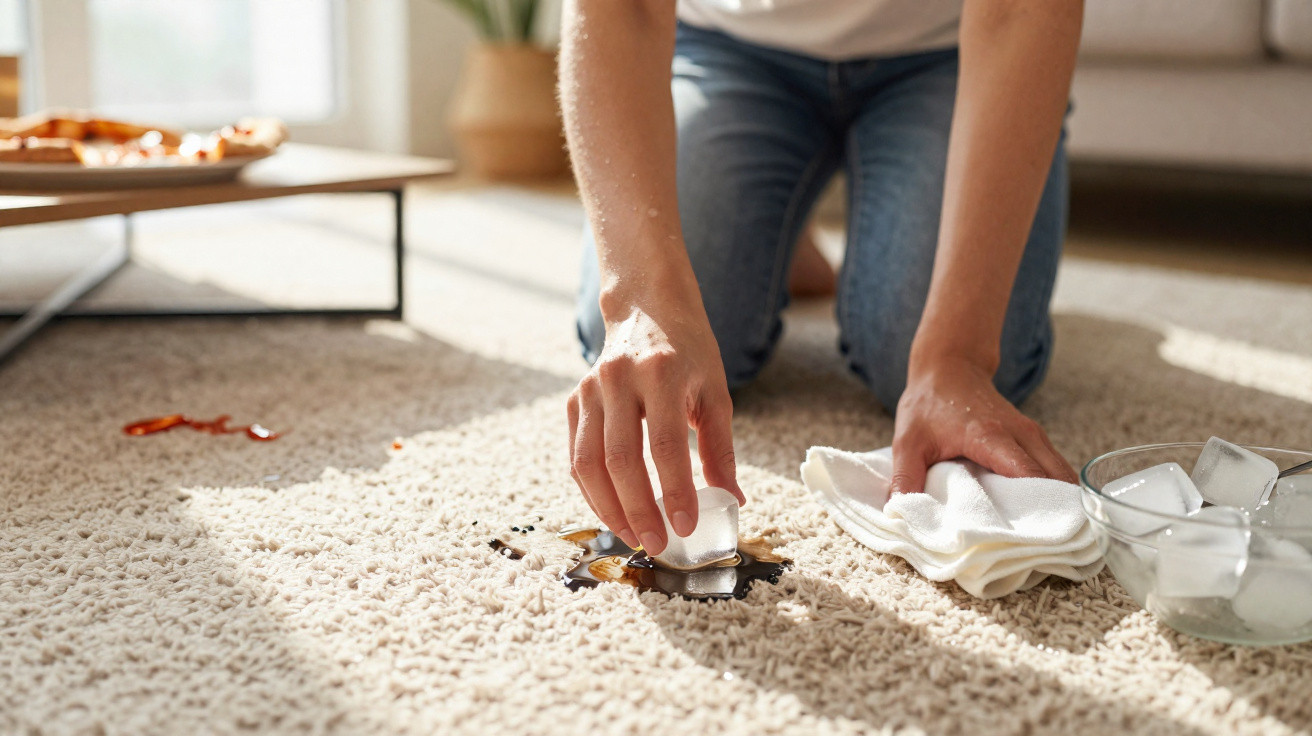
The grease stain was supposed to be dealt with already. Or so I thought. The guests had gone, the evening had been lovely, yet the carpet seemed to be smirking at me: a small oily scandal right in the middle of the living room. A shiny circle of raclette cheese sat beside the coffee table, precisely where everyone’s eyes would land first. I crouched in front of it armed with kitchen roll, washing-up liquid and stain spray – and watched the mark work its way deeper into the fibres rather than disappear.
“Leave it alone for a moment,” a friend said matter-of-factly, returning from the kitchen with an ice cube. An ice cube for grease. I laughed, more from desperation than belief. Then I watched the carpet change under the cold, and this improvised home remedy suddenly began to seem oddly, almost logically, magical.
By the end, there was only a slightly damp patch left: no oily sheen and no drama. I could not stop wondering what, exactly, had happened.
Why a grease stain on carpet can be so stubborn
We all know that moment when a piece of pizza, a splash of fat or a blob of sauce makes its way from the plate to the carpet. Our first instinct is to dab frantically with napkins, rub far too hard and mutter a few quiet curses. Then we realise the stain has not gone; it has merely become less visible while moving further into the fabric. Carpet fibres act like tiny tunnels that practically invite grease to settle in comfortably.
Many conventional cleaning products are not designed for this sort of “trapped” grease at all. They may loosen the surface, but they do not reach the residue lodged inside the fibres. That is how the familiar shadow appears – the one that never quite goes away. You wipe, spray and hope, until eventually you move the coffee table a few centimetres to the left. That is the point at which the home starts training us, rather than the other way round.
One story has stayed with me: a mother told me, while we were talking in her kitchen, how her child had spread an entire serving of gravy across a pale wool carpet. “I was on the verge of simply throwing the carpet away,” she says with a laugh, though the memory clearly still hurts. First came the all-purpose cleaner, then gall soap, followed by a supermarket carpet foam with big promises on its bottle. The stain never vanished completely; it was simply smeared into an ever wider patch.
Later, she came across the ice-cube tip in an online forum. “It sounded completely like an internet myth,” she says. With little expectation, she gave it a go. Freeze, crumble, vacuum, treat afterwards – and suddenly the greasy disaster had become an ordinary, lightly worn carpet. Not showroom-perfect, but perfectly usable in daily life. One sentence of hers sticks in the mind: “I remembered more than any advert ever taught me: grease likes warmth, not cold.”
That is precisely the practical principle behind this method. Grease behaves like a thick, sticky guest while it is warm, or at least still flexible. It clings around the fibres, penetrates them and combines with dust and dirt. When it is cooled sharply, its consistency changes: it becomes firmer, more brittle and less pliable. That suddenly makes it easier to handle. Rather than coating a fibre like a film, it becomes something that can be lifted, scraped away or vacuumed up. Let’s be honest: nobody brings in a professional carpet cleaner for every tiny stain. Most people, however, have an ice-cube tray in the freezer.
Once you understand that grease is all about temperature, structure and contact time, you start viewing this unremarkable cube of frozen water differently. It is not a magic wand, but it is a straightforward way to put physics on your side. For carpets that cannot simply be put in the washing machine, that can be a game changer.
The ice-cube method for grease stains on carpet: step by step
The basic idea sounds almost too simple: cool the grease stain with ice cubes until the grease hardens, remove it mechanically, and only then use a mild cleaner. Always begin by carefully blotting a fresh stain with kitchen roll. Do not rub or drag it back and forth; simply apply gentle pressure so that excess grease is absorbed. Anything that will not come away at that stage is left for the ice treatment.
Next come the ice cubes. Ideally, wrap them in a thin cloth or place them in a small freezer bag, so the carpet is cooled without becoming soaked. Rest the cold surface on the stain for several minutes, lifting it briefly from time to time to check how the texture is changing. Once the grease looks noticeably harder and duller, gently lift it from the fibre surface using the back of a spoon, a blunt knife edge or even your fingernails. Only afterwards is it worth using a small amount of lukewarm (!) soapy water to remove what remains.
Most people do not fail because the method is ineffective; they fail because they are impatient. We live in a world where everything is expected to work “instantly”, including cleaning. Anyone who removes the ice cube after a few seconds and says, “It doesn’t work,” is giving up too soon. Grease needs time to freeze through properly, especially in thick-pile carpets. One common mistake is using too much water. If the carpet is drenched, the grease simply travels deeper instead of solidifying. It is better to cool the surface precisely and for longer than to drown everything as quickly as possible.
Another classic error is using tools that are too aggressive. A sharp knife or stiff brush can damage the fibres faster than the stain disappears. A blunt spoon, a soft cotton cloth and a little patience are all this method requires. There is also one quiet but important point: a heavily used carpet will never look exactly as it did when it left the showroom. The ice-cube method is not a Photoshop filter; it is an honest, practical rescue for everyday life.
At one point, a professional carpet cleaner said something to me that put these small household remedies in a different light:
“The best tricks are the ones people actually use – not the ones left gathering dust in a cupboard.”
Over her career, she has seen countless carpets, from hand-knotted family heirlooms to inexpensive living-room rugs from furniture shops. For everyday situations, she recommends a kind of mental checklist for deciding when an ice cube is a better first move than bringing out the heavy-duty chemicals:
- A fresh, clearly visible grease stain (oil, butter, cheese or sauce)
- A carpet that is not washable, is fitted, or is too large for a washing machine
- No highly delicate fibres, such as pure silk, and no antique pieces
- No stain that has already been extensively rubbed in through earlier scrubbing
- No highly colour-sensitive fibre that reacts badly to temperature shocks
She stresses that a simple ice cube is often a better starting point than an arsenal of specialist products that only get used once a year. She is equally frank that everyday life wins against some stains. Yet the sooner the ice cube is used, the longer the carpet remains an ally rather than the silent witness to every mishap.
What this small trick reveals about everyday life
Anyone who has seen a stubborn grease stain tamed with a simple ice cube begins to look at their home differently. The carpet is no longer just decoration, but a stage for small accidents that do not need to be hidden. Instead of planning the next party around the thought, “Just don’t spill anything on the carpet”, you become more relaxed. Mistakes happen, drops fall, children spill things, and guests are people rather than pieces of furniture.
It is striking how strongly such an ordinary household tip affects our sense of control. When you know how to deal with unwanted marks, you fear them less. A grease stain no longer becomes an immediate threat, but a problem with a plan: cool first, loosen next, then care for the carpet. If you like, you can add a little carpet-care product or bicarbonate of soda to absorb odours. Suddenly, the carpet feels less fragile and more resilient – almost like a quiet witness to the life being lived in the room.
Perhaps the real appeal of this method is not the ice cube itself, but the feeling that you do not always have to reach for the most drastic solution. A little understanding of physics, a modest amount of time, an eye for materials and structure – plus an everyday tip that is easy to pass on. These are exactly the sorts of ideas that travel from kitchen to kitchen, from WhatsApp chat to family gathering.
Someone points at a carpet and says: “Do you remember that stain from back then? I cracked it with an ice cube.” Somewhere around the table, that sentence is quietly stored away. Until a drop of oil hits someone else’s carpet, and a trip to the freezer suddenly becomes more than simply reaching for a piece of frozen water.
| Key point | Detail | Benefit for the reader |
|---|---|---|
| Ice cools grease | Grease becomes hard and brittle rather than soft and greasy | The stain is easier to remove mechanically |
| Gentle approach | Blot, cool, lift carefully, then clean | Lower risk of damaging carpet fibres |
| Practical everyday tip | Only ice cubes, a cloth and mild cleaning product are needed | A quick solution without specialist products or professional cleaning |
FAQ:
- Can I use the ice-cube method on every carpet? It works well on most synthetic carpets and durable wool carpets. Delicate materials such as silk or antique pieces should be treated more cautiously and, when in doubt, cleaned by a specialist.
- What should I do if the grease stain is old? Older stains can also benefit from cooling because old grease becomes firmer again. The chances of success are lower, but trying an ice cube and gentle removal can noticeably reduce the stain.
- Can I use cold packs instead of ice cubes? Yes, as long as they are clean, sealed and do not soak the carpet directly. A thin cloth between the cold pack and carpet protects the fibres from excessive temperature differences and moisture.
- Which cleaning product should I use afterwards? A mixture of lukewarm water and a few drops of mild washing-up liquid is often enough. Blot with a soft cloth rather than rubbing, then go over the area with clean water so that no soap residue remains.
- What if a shadow remains after treatment? Slight shadows can be normal on pale carpets, especially if the stain was large. A second treatment or some bicarbonate of soda, left to dry and then vacuumed, may help. If the shadow is bothersome or the carpet is valuable, it is worth consulting a professional.


Comments
No comments yet. Be the first to comment!
Leave a Comment